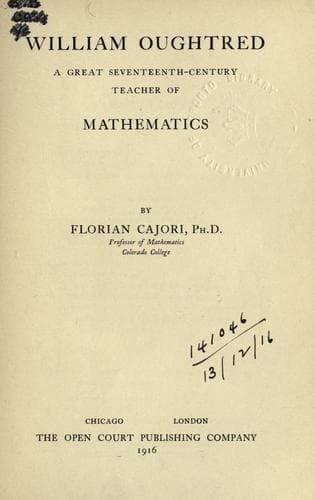
William Oughtred: A Great Seventeenth-Century Teacher of MathematicsCajori, Florian
History
William Oughtred: A Great Seventeenth-Century Teacher of Mathematics
Cajori, Florian
Mathematicians -- Biography; Mathematics -- Study and teaching -- History -- 17th century; Oughtred, William, 1575-1660
24, namely,
3..2::72..48. Curious notations are given in Rich. Balam’s Algebra,
London, 1653.
[116]Chr. Clavii Operum mathematicorum tomus secundus, Mayence, 1611,
Algebra, p. 39.
[117]Invention nouvelle en l’algèbre, by Albert Girard, Amsterdam, 1629,
p. 17.
[118]La géométrie et pratique générale d’icelle, par I. Errard de
Bar-le-Duc, Ingénieur ordinaire de sa Majesté, 3d ed., revised by D.
H. P. E. M., Paris, 1619, p. 216.
[119]Novae geometriae clavis algebra, authore P. Jacobo de Billy, Paris,
1643, p. 157; also an Abridgement of the Precepts of Algebra. Written
in French by James de Billy, London, 1659, p. 346.
[120]Miscellanies: or Mathematical Lucubrations, of Mr. Samuel Foster,
Sometime publike Professor of Astronomie in Gresham Colledge in
London, London, 1659, p. 7.
[121]Quarterly Jour. of Pure and Applied Math., Vol. XLVI (London, 1915),
p. 191.
[122]Pietro Cossali, Origine, trasporto in Italia primi progressi in essa
dell’ algebra, Vol. I, Parmense, 1797, p. 52.
[123]In Is. Bullialdi astronomiae philolaicae fundamenta inquisitio
brevis, Auctore Setho Wardo, Oxford, 1653, p. 1.
[124]John Wallis, Algebra, London, 1685, p. 321, and in some of his other
works. He makes greater use of Harriot’s symbols.
[125]Euclidis data, 1657, p. 1; also Euclidis elementorum libris XV,
London, 1659, p. 1.
[126]John Kersey, Algebra, London, 1673, p. 321.
[127]E. Wells, Elementa arithmeticae numerosae et speciosae, Oxford,
1698, p. 142.
[128]Cocker’s Decimal Arithmetick, perused by John Hawkins, London, 1695
(preface dated 1684), p. 278.
[129]Th. Baker, The Geometrical Key, London, 1684, p. 15.
[130]Richard Sault, A New Treatise of Algebra, London (no date).
[131]Richard Rawlinson in a pamphlet without date, issued sometime
between 1655 and 1668, containing trigonometric formulas. There is a
copy in the British Museum.
[132]F. Dulaurens, Specima mathematica, Paris, 1667, p. 1.
[133]J. Milnes, Sectionum conicarum elementa, Oxford, 1702, p. 42.
[134]Cheyne, Philosophical Principles of Natural Religion, London, 1705,
p. 55.
[135]J. Craig, De calculo fluentium, London, 1718, p. 86.
[136]Jo. Wilson, Trigonometry, 2d ed., Edinburgh, 1724, p. v.
[137]Commercium Epistolicum, 1712, p. 20.
[138]C. Le Paige, “Sur l’origine de certains signes d’opération,” Annales
de la société scientifique de Bruxelles, 16th year, 1891-92, Part II,
pp. 79-82.
[139]Gravelaar, “Over den oorsprong van ons maalteeken (×),” Wiskundig
Tijdschrift, 6th year. We have not had access to this article.
[140]H. Bosmans, op. cit., p. 40.
[141]Claudii Ptolemaei . . . . annotationes, Bâle, 1551. This reference
is taken from the Encyclopédie des sciences mathématiques, Tome I,
Vol. I, Fasc. 1, p. 40.
Public-domain text, read in full here on John Shaqi.
Reviews
Reviews
No reviews yet
Be the first to share your thoughts on this work.
Elsewhere in the archive
Join the Discussion
Join the discussion
Sign in to leave a comment or review.
Sign InorCreate an account