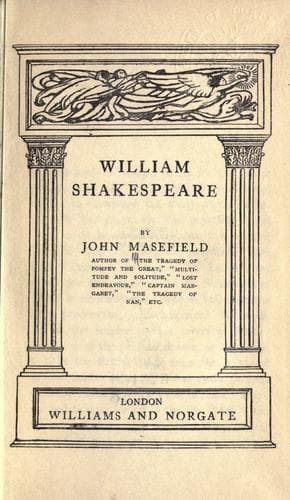
Shakespeare, William, 1564-1616 -- Criticism and interpretation
The play is full of experiments. Some of it is written in a loose,
swinging couplet, some in quatrains, some in blank verse, some in the
choice, picked prose made the fashion by Lyly. It contains more lyrics
than any other Shakespearean play. One of the lyrics, a sonnet in
Alexandrines, is the fruit of a real human passion. The lyric at the end
of the play is the loveliest thing ever said about England. If this play
and most of the other plays were modern works, the Censor would not
allow them to be performed publicly. The men and women converse with a
frankness and suggestiveness not now usual, except among the young.
Shakespeare is blamed for not conforming to standards unknown to his
generation.
He is blamed for not being delicate-minded like the great Greek tragic
poets. The Greek tragic poets wrote about the heroic life of legend.
Shakespeare wrote about life. A man who writes about life must accept
life for what it is, as largely an animal thing. Those who pretend that
life is only lived in boudoirs, are in peril, and the world is in peril
through them.
_The Two Gentlemen of Verona._
_Written._ Before 1592.
_Published_, in the first folio, 1623.
_Source of the Plot._ The story of a woman who follows her lover in
the disguise of a page-boy, hears him serenade another woman, and
acts as a go-between in his suit to this other woman, is to be
found in the second book of _La Diana Enamorada_, a pastoral
romance, in prose, freely sprinkled with lyrics, by Jorge de
Montemayor, a Portuguese who wrote in Spanish about the middle of
the sixteenth century. De Montemayor's story is not complicated by
a Valentine. He calls the girl Felismena, her lover Felix, and the
second woman Celia. His tale ends with Celia dying for love of the
supposed page-boy.
A play based on this story was acted in England in 1584. It is now
lost. The gist of the story was published in lame English verses,
by Barnabe Googe, in 1563.
_The Fable._ Valentine and Proteus, the two gentlemen, are friends.
Valentine is about to travel. Proteus, in love with Julia, will not
go with him. Antonio, Proteus' father, sends Proteus after
Valentine. Julia resolves to follow him in boy's clothes. Valentine
at Milan falls in love with the Duke's daughter, Silvia, whom the
Duke plans to marry to one Thurio. Proteus, arriving at Milan, also
falls in love with Silvia. He becomes jealous of Valentine.
Valentine tells him that he has planned to escape with Silvia that
night. Proteus betrays this plot to the Duke. The Duke banishes
Valentine and sends Proteus to Silvia to press the suit of Thurio.
Valentine joins a gang of outlaws.
Proteus woos Silvia for himself, and is rejected by her.
Public-domain text, read in full here on John Shaqi.
Reviews
Reviews
No reviews yet
Be the first to share your thoughts on this work.
Join the Discussion
Join the discussion
Sign in to leave a comment or review.
Sign InorCreate an account