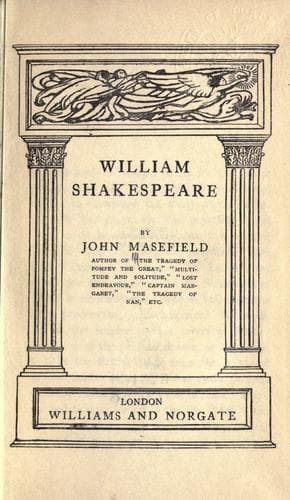
Shakespeare, William, 1564-1616 -- Criticism and interpretation
The _Menaechmi_ of Plautus is a piece of very skilful theatrical craft.
It is almost heartless. In bringing it out of the Satanic kingdom of
comedy into the charities of a larger system Shakespeare shows for the
first time a real largeness of dramatic instinct. In his handling of the
tricky ingenious plot he achieves (what, perhaps, he wrote the play to
get) a dexterous, certain play of mind. He strikes the ringing note,
time after time. It cannot be said that the verse, or the sense of
character, or the invention is better than in the other early plays. It
is not. The play is on a lower plane than any of his other works. It is
the only Shakespearean play without a deep philosophical idea. If it be
not a special commission, or an exercise in art, it is perhaps another
instance of the price great men pay for being happy. It is certainly the
fruit of a happier mood than that which bore the other early plays. It
is also the first play that shows a fine, sustained power of dramatic
construction.
It is so well constructed (for the simple Elizabethan theatre and the
bustle of the Elizabethan speech) that any unspoiled mind is held by it,
when it is acted as Shakespeare meant it to be acted. The closeness and
firmness of the dramatic texture is the work of an acutely clear mind
driven at white heat and mercilessly judged at each step. Those who do
not understand the nature of dramatic art should read the ninety odd
verses in which AEgeon tells his story (in Act I, sc. i). They would do
well to consider the power of mind that has told so much in so few
words. They will find an instance of Shakespeare's happy use of stage
trick, in the final scene, where, after the general recognition, Dromio
of Syracuse again mistakes Antipholus of Ephesus for his master.
Rare poetical power is shown in the making of the play. Little beauty
adorns the action. The speech of Adriana (in Act II, sc. ii) against the
obsession of passion that leads to treachery in marriage, is passionate
and profound. It is the most deeply felt speech in the early plays.
Adriana's husband is frequenting another woman who, having the charm
that so often goes with worthlessness, has a power of attracting that is
sometimes refused to the noble. Adriana beseeches him not to break the
tie that binds them. Two souls that have been each other's are not to be
torn apart without death to one of them. With that sympathy for the
suffering mind which gives Shakespeare all his power--
("My deepest sense, how hard true sorrow hits")
he gives to her speech an unendurable reality. Reality, however
obtained, is the only cure for an obsession. As far as words can teach
in such a case Adriana's words teach the reality of her husband's sin.
Public-domain text, read in full here on John Shaqi.
Reviews
Reviews
No reviews yet
Be the first to share your thoughts on this work.
Join the Discussion
Join the discussion
Sign in to leave a comment or review.
Sign InorCreate an account