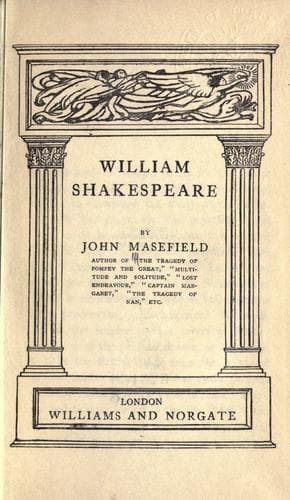
Shakespeare, William, 1564-1616 -- Criticism and interpretation
_The Fable._ The play begins with the arrival of Margaret of Anjou
at the Court of King Henry VI. An altercation among the Lords in
scene i. explains the political situation to those who have not
seen the first part of the trilogy. The subject is the gradual
ascent to power of Richard Plantagenet, Duke of York. The play is
turbulent with passions. The subject is obscured and made grander
by the war of interests and lusts among the nobles of the Court.
The Queen's party, the Duke Humphrey's party, and Cardinal
Beaufort's party, make a welter of hate and greed, against which
the Duke of York's cool purpose stands out, as Augustus stands out
against the wreck of old Rome. The action is interrupted and
lightened by the cheat of Simpcox and by the rebellion of Jack
Cade. In modern theatres the passage of time is indicated by the
dropping of a curtain and by a few words printed on a programme.
The Elizabethan theatre had neither curtain nor programme. The
passage of time was suggested by some action on the stage as here.
The play advances the tragedy of the King by removing the figures
of Duke Humphrey, the Cardinal, and the Earl of Suffolk. It ends
with the first triumph of the white rose faction, under the Duke of
York, at the battle of St. Albans.
It is plain that Shakespeare worked upon the revision of this play with
a big tragic conception. The first half of the piece is very fine. He
makes the crude, muddy, silly welter of the Contention significant and
complete. He reduces it to a simple, passionate order, deeply
impressive. The poet who worked with him, worked in sympathy with his
dramatic intention. If this poet were Marlowe, as some believe (and the
clearness of the man's brain seems to point to this), it is another
proof that the two great poets were friends during the last months of
Marlowe's life. It is plain that something stopped the revision before
it was finished. The latter half of the play is only half written. It
has flesh and blood but no life. It reads like work that has been
wrought to a pitch by two or three re-writings, and then left without
the final writing that turns imagination into vision. It would be
interesting to know why Shakespeare left the play in this state. Perhaps
there was no time to make it perfect before the rehearsals began.
Perhaps the murder of Marlowe upset the plans of the capitalist who was
speculating in the play. If it had been finished in the spirit of the
first two and a half acts it would have been one of the grandest of the
historical plays.
Public-domain text, read in full here on John Shaqi.
Reviews
Reviews
No reviews yet
Be the first to share your thoughts on this work.
Join the Discussion
Join the discussion
Sign in to leave a comment or review.
Sign InorCreate an account