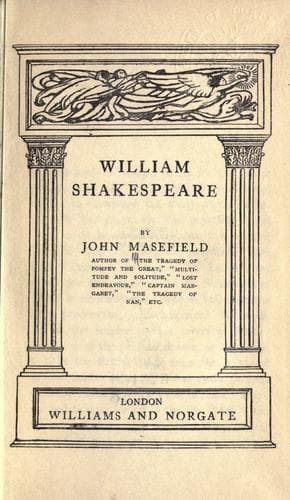
Shakespeare, William, 1564-1616 -- Criticism and interpretation
watch come too late to save her. The parents learn too late that they
have been blind. They have to clasp hands over dead bodies, that have
missed of life through their hurry to seize it.
The play tells the story of a feud greater than that of the Verona
houses. There is always feud where there is not understanding. There is
eternal feud between those two camps of misunderstanding, age and youth.
This play, written by a young man, shows the feud from the point of view
of youth. The play of King Lear shows it from the point of view of age.
This play of youth is as lovely and as feverish as love itself. Youth is
bright and beautiful, like the animals. Age is too tired to care for
brightness, too cold to care for beauty. The bright, beautiful
creatures dash themselves to pieces against the bars of age's forging,
against law, custom, duty, and those inventions of cold blood which
youth thinks cold and age knows to be wise.
Man cannot quote a minute from some hour of passion when the moon shone
and many nightingales were singing. He can hold out some flower that
blossomed then, saying, "this scent will tell you." The beauty of this
play is of that kind. The lines--
"Come, civil night,
Thou sober-suited matron, all in black"--
and the most exquisite, unmatchable lines--
"Death, that hath suck'd the honey of thy breath,
Hath had no power yet upon thy beauty:
Thou art not conquer'd; beauty's ensign yet
Is crimson in thy lips and in thy cheeks,
And death's pale flag is not advanced there"--
show with what a tender beauty the great mind feels when touched.
The Nurse gives an animal comedy to some of the scenes. She is a
tragical figure. She is the person to whom Juliet has to turn for help
at dangerous moments. There are few things sadder than the sight of the
fine soul turning to the vulgar soul in moments of need. One of the few
things sadder is the sight of wisdom failing to stop tragedy, as it
fails here, through hotness of the blood and unhappy chance. Some have
felt that the spark, Mercutio, is drawn from Shakespeare's self. Every
character in the play is drawn from Shakespeare's self. Shakespeare
found Goneril and Juliet in his mind, just as he found Mercutio and
Friar Laurence. If he may be identified with any of his characters, it
must be with those whose wisdom is like the many-coloured wisdom that
gives the plays their unity. He is in calm, wise, gentle people who
speak largely, from a vision detached from the world, as Friar Laurence
speaks--
"For nought so vile that on the earth doth live
But to the earth some special good doth give;
Nor aught so good, but, strain'd from that fair use,
Revolts from true birth, stumbling on abuse:
Virtue itself turns vice, being misapplied,
And vice sometimes by action dignified."
_King John._
_Written._ (?)
_Published_, in the first folio, 1623.
Public-domain text, read in full here on John Shaqi.
Reviews
Reviews
No reviews yet
Be the first to share your thoughts on this work.
Join the Discussion
Join the discussion
Sign in to leave a comment or review.
Sign InorCreate an account