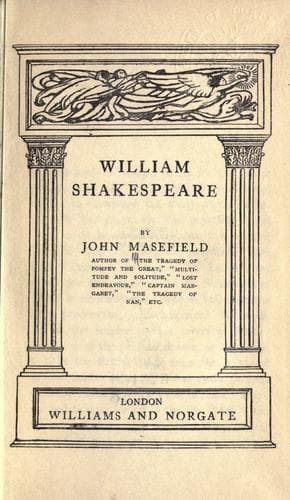
Shakespeare, William, 1564-1616 -- Criticism and interpretation
Bertram is a young man fresh from home. He does not want to marry. He is
eager to see the world and to win honour. He has been accustomed to look
down on Helena as a poor dependant. He does not like her, and he does
not like being ordered. He is suddenly ordered to marry her. He has been
trapped by a woman's underhand trick. He sees himself brought into
bondage with all the plumes of his youth clipped close. There is no way
of escape; he has to marry her; but the King's order cannot quench his
rage against the woman who has so snared him. His rage burns inward into
a brooding, rankling ill-humour that becomes an obsession. It is one of
the tragedies of life that an evil obsession blinds the judgment on more
sides than one. The obsessed are always without criticism. A way of
destruction may be as narrow as a way of virtue; but all the other ways
of destruction run into it. Bertram in blinkers to the good in Helena is
blind to the faults in himself and in Parolles his friend. Wilfully, as
the sullen do, he thinks himself justified in doing evil because evil
has been done to him. Hot blood is running in him. Temptation, never far
from youth, is always near the unbalanced. He takes an unworthy
confidant, as the obsessed do, and goes in over the ears. His sin is
the giving of salutation to sportive blood, it is love, it is "natural
rebellion," it is young man's pastime. But looked at coldly and
judicially, with the nature of the confidant laid bare, and the lies of
the sinner made plain, it is an ugly thing. Passion is sweet enough to
seem truth, the only truth. Let the eyes be opened a little, and it will
blast the heart with horror. What man thought true is then seen to be
this, this thing, this devil of falseness who gives man this kind of
friend, makes him tell this kind of lie, and brands him with this kind
of shame.
Shakespeare is just to Bertram. The treachery of a woman is often the
cause of a man's treachery to womanhood. Helena's obsession of love
makes her blind to the results of her actions. She twice puts the man
whom she loves into an intolerable position, which nothing but a king
can end. The fantasy is not made so real that we can believe in the
possibility of happiness between two so married. Helena has been praised
as one of the noblest of Shakespeare's women. Shakespeare saw her more
clearly than any man who has ever lived. He saw her as a woman who
practises a borrowed art, not for art's sake, nor for charity, but,
woman fashion, for a selfish end. He saw her put a man into a position
of ignominy quite unbearable, and then plot with other women to keep him
in that position. Lastly, he saw her beloved all the time by the
conventionally minded of both sexes.
The play is full of effective theatrical situations. It contains much
fine poetry. Besides the poetry there are startling moments of insight--
"My mother told me just how he would woo
As if she sat in's heart...."
Public-domain text, read in full here on John Shaqi.
Reviews
Reviews
No reviews yet
Be the first to share your thoughts on this work.
Join the Discussion
Join the discussion
Sign in to leave a comment or review.
Sign InorCreate an account