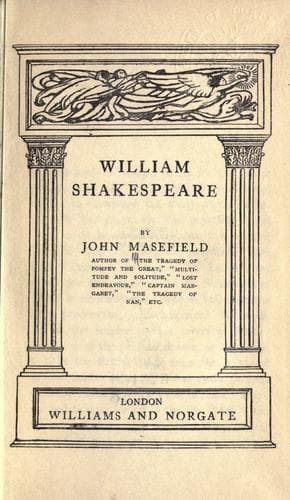
Shakespeare, William, 1564-1616 -- Criticism and interpretation
The play is kept within the bounds of fantastic comedy by the
members of the sub-plot, who intrude with their fun whenever the
action tends to become real. They intrude here, to impersonate the
Nine Worthies before the two Courts. The farce of their performance
is heightened by ragging from the courtiers. When it is at its
height, two of the members of the sub-plot begin to quarrel. One
blow would ruin the play by making it real. At the crisis the
violence is avoided; the reality is brought unexpectedly, by
beauty. A messenger enters to tell the Princess that her father is
dead.
The ladies bid the men test their love by waiting for twelve
months. The trifling of the earlier acts is shown at its moral
value against a background of tragic happening. Accomplishments are
compared with life.
The members of the sub-plot enter. They end the play with the
singing of a lyric.
The play gives the reader the uncanny feeling that something real inside
the piece is trying to get out of the fantasy. The lip-love rattles like
a skeleton's bones. The love of Biron for Rosaline is real passion. The
conflict throughout is the conflict of the unreal with the real.
The play seems to have been written in a literary or sentimental mood,
and revised in a real mood. There is little in the early version that is
not fantastic. The situation is fantastic, the people are fantastic, the
language is fantastic with all a brilliant young master's delight in the
play and glitter of cunning writing. The later version was written
during the passionate years of Shakespeare's growth, after something had
altered the world to him. The two versions are carelessly stuck
together, with the effect of a rose-bush growing out of bones.
The Biron scenes, as we have them, seem to be the fruit of the mood that
caused the sonnets. We do not know what caused that mood. The sonnets,
like the plays, are as likely to be symbol as confession. The sonnets
suggest that he loved an unworthy woman who robbed him of a beloved
friend. _Love's Labour's Lost_ and several other early plays suggest
that he knew too well how love for the unworthy woman smirches honour,
wakens, but holds captive, the reason, and wastes the spiritual gift in
the praise of a form of death.
Public-domain text, read in full here on John Shaqi.
Reviews
Reviews
No reviews yet
Be the first to share your thoughts on this work.
Join the Discussion
Join the discussion
Sign in to leave a comment or review.
Sign InorCreate an account