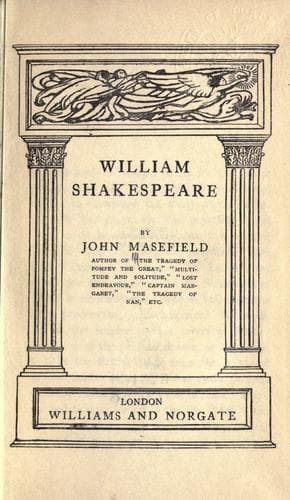
Shakespeare, William, 1564-1616 -- Criticism and interpretation
In this most noble play, Shakespeare applies to a great subject his
constant idea, that tragedy springs from the treachery caused by some
obsession.
"Strange it is
That nature must compel us to lament
Our most persisted deeds."
It cannot be said that the play is greater than the other plays of this
period. It can be said that it is on a greater scale than any other
play. The scene is the Roman world. The men engaged are struggling for
the control of all the power of the world. The private action is played
out before a grand public setting. The wisdom and the beauty of the
poetry answer the greatness of the subject.
Shakespeare's later tragedies, _King Lear_, _Coriolanus_, _Othello_, and
this play differ from some of the early tragedies in that the subject is
not the man of intellect, hounded down by the man of affairs, as in
_Richard II_, _Richard III_, and _Henry IV_, but the man of large and
generous nature hounded down by the man of intellect. In all four plays
the destruction of the principal character is brought about partly by a
blindness in a noble nature, but very largely by a cool, resolute,
astute soul who can and does take advantage of the blindness. Edmund,
the tribunes, Iago, and (in this play) Octavius Caesar are such souls.
All of them profit by the soul they help to destroy. They leave upon the
mind the impression that they have a tact for the gaining of profit from
human frailty. All of them show the basest ingratitude under a
colourable cloak of human excuse.
The obsession of lust is illustrated in half-a-dozen of Shakespeare's
plays; but in none of them so fully as here. The results of that
obsession in treachery and tragedy brim the great play. Antony is
drunken to destruction with a woman like a raging thirst. A fine stroke
in the creation of the play sweeps him clear of her and offers him a
way of life. He uses the moment to get so far from her that his return
to her is a deed of triple treachery to his wife, to Caesar, and to his
country. His intoxication with the woman degrades him to the condition
of blindness in which the woman-drunken staggers. It is a part of all
drunkenness that the drunkard thinks himself a king, though he looks and
is a sot. Shakespeare's marvellous illustration of this blindness (in
the third act) is seldom praised as it should be. Antony, crushingly
defeated, owing to the treachery of all debauched natures, calls upon
Octavius to meet him in single combat.
"men's judgments are
A parcel of their fortunes, and things outward
Do draw the inward quality after them,
To suffer all alike."
"when we in our viciousness grow hard,
O misery on't--the wise gods seel our eyes;
In our own filth drop our clear judgments; make us
Adore our errors; laugh at's while we strut
To our confusion."
Public-domain text, read in full here on John Shaqi.
Reviews
Reviews
No reviews yet
Be the first to share your thoughts on this work.
Elsewhere in the archive
Join the Discussion
Join the discussion
Sign in to leave a comment or review.
Sign InorCreate an account