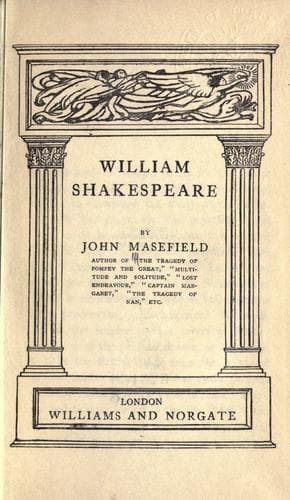
Shakespeare, William, 1564-1616 -- Criticism and interpretation
The cruel bungling suicide which leaves him lingering in dishonour is
one of the saddest things in the plays. This was Antony who ruled once,
this mutterer dying, whom no one loves enough to kill. Once before, in
Shakespeare's vision, he came near death, in the proud scene in the
senate house, before Caesar's murderers. He was very great and noble
then. Now
"The star is fall'n
And time is at his period."
"The god Hercules, whom Antony loved,"
has moved away with his hautboys and all comes to dust again.
The minds of most writers would have been exhausted after the creation
of four such acts. The splendour of Shakespeare's intellectual energy
makes the last act as bright a torch of beauty as the others. The cry--
"We'll bury him; and then, what's brave, what's noble,
Let's do it after the high Roman fashion,
And make Death proud to take us ...
.... we have no friend
But resolution and the briefest end,"
begins a song of the welcoming of death, unlike anything in the plays.
Shakespeare seldom allows a woman a great, tragical scene. Cleopatra is
the only Shakespearean woman who dies heroically upon the stage. Her
death scene is not the greatest, nor the most terrible, but it is the
most beautiful scene in all the tragedies. The words--
"Finish, good lady; the bright day is done,
And we are for the dark,"
and those most marvellous words, written at one golden time, in a gush
of the spirit, when the man must have been trembling--
"O eastern star!
Peace, peace!
Dost thou not see my baby at my breast,
That sucks the nurse asleep?"
are among the most beautiful things ever written by man.
_Coriolanus._
_Written._ 1608 (?)
_Published._ 1623.
_Source of the Plot._ The life of Coriolanus in Sir Thomas North's
translation of Plutarch's _Lives_.
_The Fable._ Marcius, a noble Roman, of an excessive pride,
bitterly opposes the rabble.
In the war against the Volscians he bears himself so nobly that he
wins the title of Coriolanus. On his return from the wars he seeks
the Consulship, woos the voices of the multitude, is accepted, and
then cast by them. For his angry comment on their behaviour the
tribunes contrive his banishment from the city.
Being banished, he makes league with the Volscians. He takes
command in the Volscian army and invades Roman territory.
Coming as a conqueror to the walls of Rome, his mother and wife
persuade him to spare the city. He causes the Volscians to make
peace. The Volscians return home dissatisfied.
On his return to the Volscian territory Coriolanus is impeached as
a traitor, and stabbed to death by conspirators.
Public-domain text, read in full here on John Shaqi.
Reviews
Reviews
No reviews yet
Be the first to share your thoughts on this work.
Elsewhere in the archive
Join the Discussion
Join the discussion
Sign in to leave a comment or review.
Sign InorCreate an account