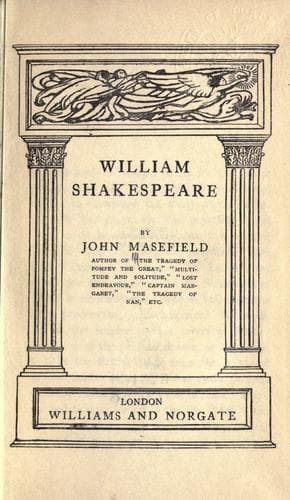
Shakespeare, William, 1564-1616 -- Criticism and interpretation
Apemantus is currish, because others are not. He has wit without
charity. Alcibiades makes war on his city because others have not the
rough-and-ready large practical justice of men used to knocks. He has a
large good humour without idealism. Timon, the great-natured, truly
generous man, whose mind is as beneficial as the sun, cannot be currish,
nor stoop to the baseness of revenge. Finding men base, he removes
himself from them, and ministers with bitter contempt to the baseness
that infects them. The flaming out of his anger against whatever is
parasitic in life makes the action of the last two acts. The exhibition
of the baseness of parasites and of the wrath of a noble mind
embittered, is contrived, varied and heightened with intense dramatic
energy. The character of Flavius, Timon's steward, his only friend,
shows again, as in so many of the plays, Shakespeare's deep sense of the
noble generosity in faithful service.
Some think the play gloomy, others that it is autobiography.
Shakespeare's completed work is never gloomy. A great mind working with
such a glory of energy cannot be gloomy. This generation is gloomy and
unimaginative in its conception of art. Shakespeare, reading the story
of Timon, saw in him an image of tragic destiny that would flood the
heart of even an ingrate with pity. Great poets have something more
difficult and more noble to do than to pin their hearts on their
sleeves for daws to peck at. Shakespeare wrought the figure of Timon
with as grave justice as he wrought Alcibiades. He wrought both from
something feeling within himself, as he wrought Cleopatra, and Macbeth,
and Sir Toby Belch. They are as much autobiographical, and as little, as
the hundred other passionate moods that built up the system of his soul.
The poetry of the play is that of the great late manner--
"will these moss'd trees,
That have outlived the eagle, page thy heels,
And skip when thou point'st out?"
"Come not to me again: but say to Athens,
Timon hath made his everlasting mansion
Upon the beached verge of the salt flood:
Who, once a day with his embossed froth
The turbulent surge shall cover."
The final speech, spoken by Alcibiades after he has read the epitaph,
with which Timon goes down to death, like some hurt thing shrinking even
from the thought of passers, is one of the most lovely examples of the
power and variety of blank verse as a form of dramatic speech.
_Alcib._ (reading) _Pass by and curse thy fill; but pass, and
stay not here thy gait._
Public-domain text, read in full here on John Shaqi.
Reviews
Reviews
No reviews yet
Be the first to share your thoughts on this work.
Elsewhere in the archive
Join the Discussion
Join the discussion
Sign in to leave a comment or review.
Sign InorCreate an account