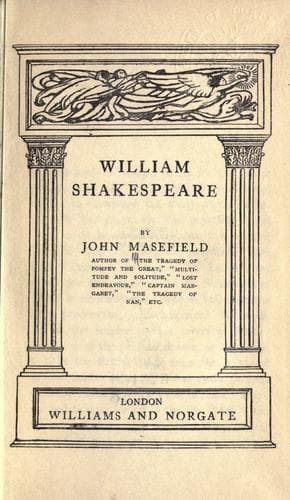
Shakespeare, William, 1564-1616 -- Criticism and interpretation
_Coriolanus_ is a play of the clash of the aristocratic temper with the
world. It contains most of the few speeches in Shakespeare which ring
with what seems like a personal bitterness. Hatred of the flunkey mind,
and of the servile, insolent mob mind, "false as water," appears in
half-a-dozen passages. Some of these passages are ironic inventions, not
prompted by Plutarch. The great mind, brooding on the many forms of
treachery, found nothing more treacherous than the mob, and nothing more
dog-like, for good or evil, than the servant.
Greatness is sometimes shown in very little things. Few things in
Shakespeare show better the fulness of his happy power than the
following--
(_Corioli. Enter certain Romans with spoils._)
_1st Roman._ This will I carry to Rome.
_2nd Roman._ And I this.
_3rd Roman._ A murrain on't. I took this for silver.
_Timon of Athens._
_Written._ 1606-8 (?)
_Published._ 1623.
_Source of the Plot._ William Paynter's _Palace of Pleasure_.
Plutarch's _Life of Antonius_. Lucian's _Dialogue_.
_The Fable._ Timon of Athens, a wealthy, over-generous man, gives
to his friends so lavishly that he ruins himself. He finds none
grateful for his bounty. In his ruin all his friends desert him.
None of them will lend to him or help him. He falls into a loathing
of the world and retires to die alone. Alcibiades of Athens,
finding a like ingratitude in the State, openly makes war upon it,
reduces it to his own terms, and rules it. He finds Timon dead.
_Timon of Athens_ is a play of mixed authorship. Shakespeare's share in
it is large and unmistakable; but much of it was written by an unknown
poet of whom we can decipher this, that he was a man of genius, a
skilled writer for the stage, and of a marked personality. It cannot
now be known how the collaboration was arranged. Either the unknown
collaborated with Shakespeare, or the unknown wrote the play and
Shakespeare revised it.
Ingratitude is one of the commonest forms of treachery. It is the form
that leads most quickly to the putting back of the world, because it
destroys generosity of mind. It creates in man the bitter and
destructive quality of misanthropy, or a destroying passion of revenge.
In this play the two authors show the different ways in which the human
mind may be turned to those bitter passions.
Public-domain text, read in full here on John Shaqi.
Reviews
Reviews
No reviews yet
Be the first to share your thoughts on this work.
Elsewhere in the archive
Join the Discussion
Join the discussion
Sign in to leave a comment or review.
Sign InorCreate an account