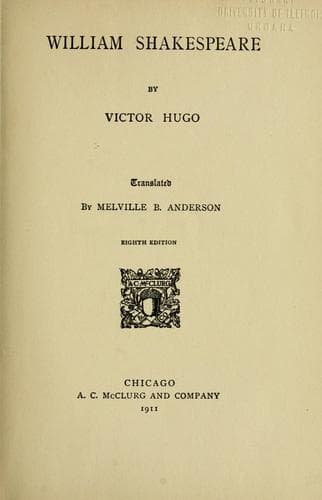
Dramatists, English -- Early modern, 1500-1700 -- Biography; Shakespeare, William, 1564-1616; Stratford-upon-Avon (England) -- Biography
Poet must at the same time, and necessarily, be a historian and a
philosopher. Herodotus and Thales are included in Homer. Shakespeare,
likewise, is this triple man. He is, besides, the painter, and what
a painter!--the colossal painter. The poet in reality does more than
relate; he exhibits. Poets have in them a reflector, observation, and
a condenser, emotion; thence those grand luminous spectres which burst
out from their brain, and which go on blazing forever on the gloomy
human wall. These phantoms have life. To exist as much as Achilles,
would be the ambition of Alexander. Shakespeare has tragedy, comedy,
fairy-land, hymn, farce, grand divine laughter, terror and horror, and,
to say all in one word, the drama. He touches the two poles. He belongs
to Olympus and to the travelling booth. No possibility fails him.
When he grasps you, you are subdued. Do not expect from him any pity.
His cruelty is pathetic. He shows you a mother,--Constance, mother
of Arthur; and when he has brought you to that point of tenderness
that your heart is as her heart, he kills her child. He goes farther
in horror even than history, which is difficult. He does not content
himself with killing Rutland and driving York to despair; he dips in
the blood of the son the handkerchief with which he wipes the eyes of
the father. He causes elegy to be choked by the drama, Desdemona by
Othello. No attenuation in anguish. Genius is inexorable. It has its
law and follows it. The mind also has its inclined planes, and these
slopes determine its direction. Shakespeare glides toward the terrible.
Shakespeare, Æschylus, Dante, are great streams of human emotion
pouring from the depth of their cave the um of tears.
The poet is only limited by his aim; he considers nothing but the idea
to be worked out; he does not recognize any other sovereignty, any
other necessity but the idea; for, art emanating from the absolute,
in art, as in the absolute, the end justifies the means. This is, it
may be said parenthetically, one of those deviations from the ordinary
terrestrial law which make lofty criticism muse and reflect, and
which reveal to it the mysterious side of art. In art, above all, is
visible the _quid divinum._ The poet moves in his work as providence
in its own; he excites, astounds, strikes, then exalts or depresses,
often in inverse ratio to what you expected, diving into your soul
through surprise. Now, consider. Art has, like the Infinite, a Because
superior to all the _Why's._ Go and ask the wherefore of a tempest
from the ocean, that great lyric. What seems to you odious or absurd
has an inner reason for existing. Ask of Job why he scrapes the pus on
his ulcer with a bit of glass, and of Dante why he sews with a thread
of iron the eyelids of the larvas in purgatory, making the stitches
trickle with fearful tears![1] Job continues to clean his sore with his
broken glass and wipes it on his dungheap, and Dante goes on his way.
The same with Shakespeare.
Public-domain text, read in full here on John Shaqi.
Reviews
Reviews
No reviews yet
Be the first to share your thoughts on this work.
Elsewhere in the archive
Join the Discussion
Join the discussion
Sign in to leave a comment or review.
Sign InorCreate an account