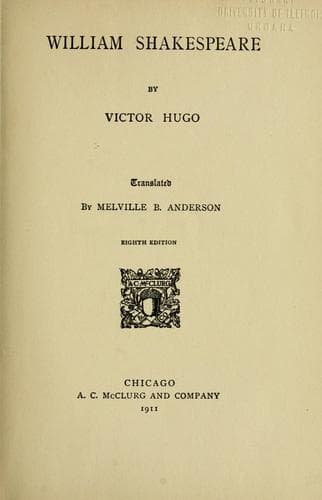
Dramatists, English -- Early modern, 1500-1700 -- Biography; Shakespeare, William, 1564-1616; Stratford-upon-Avon (England) -- Biography
Marmontel comes to see Voltaire at Ferney. Voltaire is in bed, holding
a book in his hand; all at once he rises up, throws the book away,
stretches his thin legs across the bed, and cries to Marmontel, "Your
Shakespeare is a barbarian!" "He is not my Shakespeare at all," replies
Marmontel.
Shakespeare was an occasion for Voltaire to show his skill at the
target Voltaire missed him rarely. Voltaire shot at Shakespeare as
the peasants shoot at the goose. It was Voltaire who had commenced
in France the attack against that barbarian. He nicknamed him the
Saint Christopher of Tragic Poets. He said to Madame de Graffigny,
"Shakespeare pour rire." He said to Cardinal de Bernis, "Compose pretty
verses; deliver us, monsignor, from plagues, witches, the school of
the King of Prussia, the Bull Unigenitus, the constitutionalists and
the convulsionists, and from that ninny Shakespeare! _Libera nos,
Domine_," The attitude of Fréron toward Voltaire has, in the eyes of
posterity, as an attenuating circumstance, the attitude of Voltaire
toward Shakespeare. Nevertheless, throughout the eighteenth century,
Voltaire gives the law. The moment that Voltaire sneers at Shakespeare,
Englishmen of wit, such as my Lord Marshal follow suit. Johnson
confesses the ignorance and vulgarity of Shakespeare. Frederic II.
comes in for a word also. He writes to Voltaire _à propos_ of "Julius
Cæsar:" "You have done well in re-casting, according to principles,
the crude piece of that Englishman." Behold, then, where Shakespeare
is in the last century. Voltaire insults him. La Harpe protects him:
"Shakespeare himself, coarse as he was, was not without reading and
knowledge."[3]
In our days, the class of critics of whom we have just seen some
samples, have not lost courage. Coleridge speaks of "Measure for
Measure:" "a painful comedy," he hints. "Revolting," says Mr. Knight.
"Disgusting," responds Mr. Hunter.
In 1804 the author of one of those idiotic _Biographies Universelles_,
in which they contrive to relate the history of Calas without
pronouncing the name of Voltaire, and to which governments, knowing
what they are about, grant readily their patronage and subsidies, a
certain Delandine feels himself called upon to be a judge, and to
pass sentence on Shakespeare; and after having said that "Shakespear,
which is pronounced Chekspir," had, in his youth, "stolen the deer of
a nobleman," he adds: "Nature had brought together in the head of this
poet the highest greatness we can imagine, with the lowest coarseness,
without wit." Lately, we read the following words, written a short time
ago by an eminent dolt who is living: "Second-rate authors and inferior
poets, such as Shakespeare," etc.
[Footnote 1: A Groatsworth of Wit. 1592.]
[Footnote 2: Works, vol IX. p. 175, Gifford's edition.]
[Footnote 3: La Harpe: _Introduction au Cours de Littérature._]
CHAPTER II.
Public-domain text, read in full here on John Shaqi.
Reviews
Reviews
No reviews yet
Be the first to share your thoughts on this work.
Elsewhere in the archive
Join the Discussion
Join the discussion
Sign in to leave a comment or review.
Sign InorCreate an account