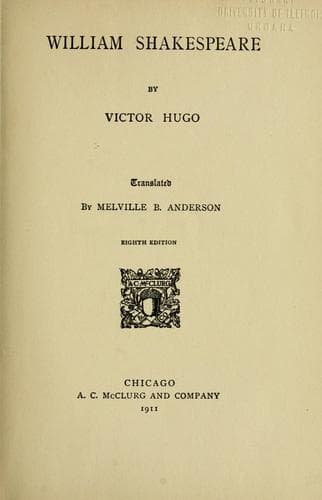
Dramatists, English -- Early modern, 1500-1700 -- Biography; Shakespeare, William, 1564-1616; Stratford-upon-Avon (England) -- Biography
Deformity in the person of the tyrant is not enough for this
philosopher; he must have it also in the shape of the valet, and he
creates Falstaff. The dynasty of common-sense, inaugurated in Panurge,
continued in Sancho Panza, goes wrong and miscarries in Falstaff. The
rock which this wisdom splits upon is, in reality, lowness. Sancho
Panza, in combination with the ass, is embodied with ignorance.
Falstaff-glutton, poltroon, savage, obscene, human face and stomach,
with the lower parts of the brute--walks on the four feet of turpitude;
Falstaff is the centaur man and pig.
Shakespeare is, above all, an imagination. Now,--and this is a
truth to which we have already alluded, and which is well known to
thinkers,--imagination is depth. No faculty of the mind goes and sinks
deeper than imagination; it is the great diver. Science, reaching the
lowest depths, meets imagination. In conic sections, in logarithms,
in the differential and integral calculus, in the calculation of
probabilities, in the infinitesimal calculus, in the calculations
of sonorous waves, in the application of algebra to geometry, the
imagination is the co-efficient of calculation, and mathematics
becomes poetry. I have no faith in the science of stupid learned men.
The poet philosophizes because he imagines. That is why Shakespeare
has that sovereign management of reality which enables him to have his
way with it; and his very whims are varieties of the true,--varieties
which deserve meditation. Does not destiny resemble a constant whim?
Nothing more incoherent in appearance, nothing less connected, nothing
worse as deduction. Why crown this monster, John? Why kill that child,
Arthur? Why have Joan of Arc burned? Why Monk triumphant? Why Louis XV.
happy? Why Louis XVI. punished? Let the logic of God pass. It is from
that logic that the fancy of the poet is drawn. Comedy bursts forth
in the midst of tears; the sob rises out of laughter; figures mingle
and clash; massive forms, nearly animals, pass clumsily; larvas--women
perhaps, perhaps smoke--float about; souls, libellulas of darkness,
flies of the twilight, quiver among all these black reeds that we call
passions and events. At one pole Lady Macbeth, at the other Titania. A
colossal thought, and an immense caprice.
Public-domain text, read in full here on John Shaqi.
Reviews
Reviews
No reviews yet
Be the first to share your thoughts on this work.
Elsewhere in the archive
Join the Discussion
Join the discussion
Sign in to leave a comment or review.
Sign InorCreate an account