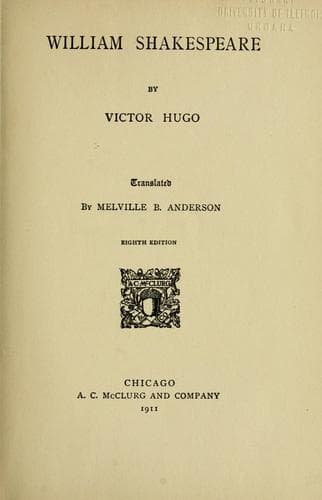
Dramatists, English -- Early modern, 1500-1700 -- Biography; Shakespeare, William, 1564-1616; Stratford-upon-Avon (England) -- Biography
What are the "Tempest," "Troilus and Cressida," "The Two Gentlemen of
Verona," "The Merry Wives of Windsor," the "Midsummer Night's Dream,"
"The Winter's Tale?" They are fancy,--arabesque work. The arabesque
in art is the same phenomenon as vegetation in Nature. The arabesque
grows, increases, knots, exfoliates, multiplies, becomes green, blooms,
branches, and creeps around every dream. The arabesque is endless; it
has a strange power of extension and aggrandizement; it fills horizons,
and opens up others; it intercepts the luminous deeds by innumerable
intersections; and, if you mix the human figure with these entangled
branches, the _ensemble_ makes you giddy; it is striking. Behind
the arabesque, and through its openings, all philosophy can be seen;
vegetation lives; man becomes pantheist; a combination of infinite
takes place in the finite; and before such work, in which are found
the impossible and the true, the human soul trembles with an emotion
obscure and yet supreme.
For all this, the edifice ought not to be overrun by vegetation, nor
the drama by arabesque.
One of the characteristics of genius is the singular union of faculties
the most distant. To draw an astragal like Ariosto, then to dive into
souls like Pascal,--such is the poet Man's inner conscience belongs
to Shakespeare; he surprises you with it constantly. He extracts
from conscience every unforeseen contingence that it contains. Few
poets surpass him in this psychical research. Many of the strangest
peculiarities of the human mind are indicated by him. He skilfully
makes us feel the simplicity of the metaphysical fact under the
complication of the dramatic fact. That which the human creature does
not acknowledge inwardly, the obscure thing that he begins by fearing
and ends by desiring,--such is the point of junction and the strange
place of meeting for the heart of virgins and the heart of murderers;
for the soul of Juliet and the soul of Macbeth. The innocent fears and
longs for love, just as the wicked one for ambition. Perilous kisses
given on the sly to the phantom, smiling here, fierce there.
Public-domain text, read in full here on John Shaqi.
Reviews
Reviews
No reviews yet
Be the first to share your thoughts on this work.
Elsewhere in the archive
Join the Discussion
Join the discussion
Sign in to leave a comment or review.
Sign InorCreate an account