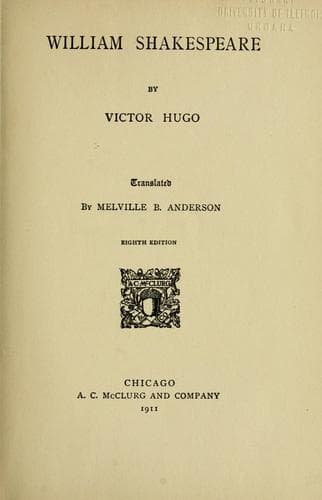
Dramatists, English -- Early modern, 1500-1700 -- Biography; Shakespeare, William, 1564-1616; Stratford-upon-Avon (England) -- Biography
Complete minds having everything, Shakespeare contains Gongora as
Michael Angelo contains Bernini; and there are on that subject
ready-made sentences: "Michael Angelo is a mannerist, Shakespeare is
antithetical." These are the formulas of the school; but it is the
great question of contrast in art seen by the small side.
_Totus in antithesi._ Shakespeare is all in antithesis. Certainly, it
is not very just to see all the man, and such a man, in one of his
qualities. But, this reserve being made, let us observe that this
saying, _Totus in antithesi_, which pretends to be a criticism, might
be simply a statement. Shakespeare, in fact, has deserved, like all
truly great poets, this praise,--that he is like creation. What is
creation? Good and evil, joy and sorrow, man and woman, roar and song,
eagle and vulture, lightning and ray, bee and drone, mountain and
valley, love and hate, the medal and its reverse, beauty and ugliness,
star and swine, high and low. Nature is the Eternal bifronted. And this
antithesis, whence comes the antiphrasis, is found in all the habits
of man; it is in fable, in history, in philosophy, in language. Are
you the Furies, they call you Eumenides,--the Charming; do you kill
your brothers, you are called Philadelphus; kill your father, they
will call you Philopator; be a great general, they will call you _le
petit caporal._ The antithesis of Shakespeare is universal antithesis,
always and everywhere; it is the ubiquity of antinomy,--life and
death, cold and heat, just and unjust, angel and demon, heaven and
earth, flower and lightning, melody and harmony, spirit and flesh,
high and low, ocean and envy, foam and slaver, hurricane and whistle,
self and not-self, the objective and subjective, marvel and miracle,
type and monster, soul and shadow. It is from this sombre palpable
difference, from this endless ebb and flow, from this perpetual yes
and no, from this irreducible opposition, from this immense antagonism
ever existing, that Rembrandt obtains his chiaroscuro and Piranesi his
vertiginous height.
Before removing this antithesis from art, commence by removing it from
Nature.
CHAPTER IV.
"He is reserved and discreet. You may trust him; he will take no
advantage. He has, above all, a very rare quality,--he is sober."
Public-domain text, read in full here on John Shaqi.
Reviews
Reviews
No reviews yet
Be the first to share your thoughts on this work.
Elsewhere in the archive
Join the Discussion
Join the discussion
Sign in to leave a comment or review.
Sign InorCreate an account