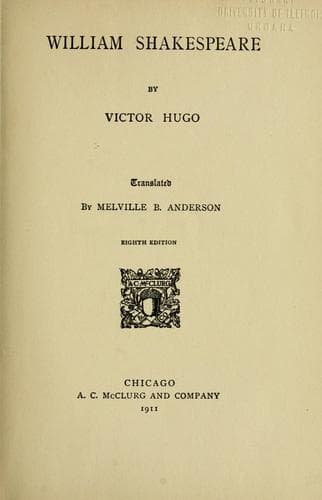
Dramatists, English -- Early modern, 1500-1700 -- Biography; Shakespeare, William, 1564-1616; Stratford-upon-Avon (England) -- Biography
To all these prodigalities, analysis, synthesis, creation in flesh
and bone, revery, fancy, science, metaphysics, add history,--here the
history of historians, there the history of the tale; specimens of
everything,--of the traitor, from Macbeth the assassin of his guest,
up to Coriolanus, the assassin of his country; of the despot, from
the intellectual tyrant Cæsar, to the bestial tyrant Henry VIII.; of
the carnivorous, from the lion down to the usurer. One may say to
Shylock: "Well bitten, Jew!" And, in the background of this wonderful
drama, on the desert heath, in the twilight, in order to promise crowns
to murderers, three black outlines appear, in which Hesiod, through
the vista of ages, perhaps recognizes the Parcæ. Inordinate force,
exquisite charm, epic ferocity, pity, creative faculty, gayety (that
lofty gayety unintelligible to narrow understandings), sarcasm (the
cutting lash for the wicked), star-like greatness, microscopic tenuity,
boundless poetry, which has a zenith and a nadir; the _ensemble_ vast,
the detail profound,--nothing is wanting in this mind. One feels, on
approaching the work of this man, the powerful wind which would burst
forth from the opening of a whole world. The radiancy of genius on
every side,--that is Shakespeare. "Totus in antithesi," says Jonathan
Forbes.
[Footnote 1:
And as the sun does not reach the blind, so the spirits of
which I was just speaking have not the gift of heavenly
light. An iron wire pierces and fastens together their
eyelids, as it is done to the wild hawk in order to tame it.
--_Purgatory, chap. XIII._]
CHAPTER III.
One of the characteristics which distinguish men of genius from
ordinary minds, is that they have a double reflection,--just as the
carbuncle, according to Jerome Cardan, differs from crystal and glass
in having a double refraction.
Genius and carbuncle, double reflection, double refraction; the same
phenomenon in the moral and in the physical order.
Does this diamond of diamonds, the carbuncle, exist? It is a question.
Alchemy says yes, chemistry searches. As for genius, it exists. It is
sufficient to read one verse of Æschylus or Juvenal in order to find
this carbuncle of the human brain.
This phenomenon of double reflection raises to the highest power in
men of genius what rhetoricians call antithesis,--that is to say, the
sovereign faculty of seeing the two sides of things.
I dislike Ovid, that proscribed coward, that licker of bloody hands,
that fawning cur of exile, that far-away flatterer disdained by the
tyrant, and I hate the _bel esprit_ of which Ovid is full; but I do not
confound that _bel esprit_ with the powerful antithesis of Shakespeare.
Public-domain text, read in full here on John Shaqi.
Reviews
Reviews
No reviews yet
Be the first to share your thoughts on this work.
Elsewhere in the archive
Join the Discussion
Join the discussion
Sign in to leave a comment or review.
Sign InorCreate an account