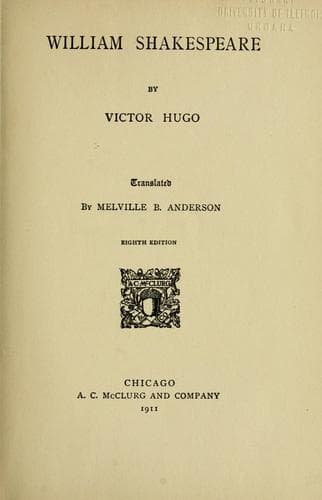
Dramatists, English -- Early modern, 1500-1700 -- Biography; Shakespeare, William, 1564-1616; Stratford-upon-Avon (England) -- Biography
M. Suard gave to Marie Joseph Chénier this certificate: "His style has
the great merit of not containing comparisons." In our days we have
seen that singular eulogium reproduced. This reminds us that a great
professor of the Restoration, indignant at the comparisons and figures
which abound in the prophets, crushes Isaiah, Daniel, and Jeremiah,
with this profound apothegm: "The whole Bible is in 'like' (_comme_)."
Another, a greater professor still, was the author of this saying,
which is still celebrated at the normal school: "I throw Juvenal back
to the romantic dunghill." Of what crime was Juvenal guilty? Of the
same as Isaiah,--namely, of readily expressing the idea by the image.
Shall we return, little by little, in the walks of learning, to the
metonymy term of chemistry, and to the opinion of Pradon on metaphor?
One would suppose, from the demands and clamours of the doctrinary
school, that it has to supply, at its own expense, all the consumption
of metaphors and figures that poets can make, and that it feels
itself ruined by spendthrifts such as Pindar, Aristophanes, Ezekiel,
Plautus, and Cervantes. This school puts under lock and key passions,
sentiments, the human heart, reality, the ideal, life. Frightened,
it looks at the men of genius, hides from them everything, and says,
"How greedy they are!" Therefore it has invented for writers this
superlative praise: "He is temperate."
On all these points sacerdotal criticism fraternizes with doctrinal
criticism. The prude and the devotee help each other.
A curious bashful fashion tends to prevail. We blush at the coarse
manner in which grenadiers meet death; rhetoric has for heroes modest
vine-leaves which they call periphrases; it is agreed that the bivouac
speaks like the convent, the talk of the guardroom is a calumny; a
veteran drops his eyes at the recollection of Waterloo, and the Cross
of Honour is given to these modest eyes. Certain sayings which are in
history have no right to be historical; and it is well understood, for
example, that the gendarme who fired a pistol at Robespierre at the
Hôtel-de-Ville was called _La-garde-meurt-et-ne-se-rend-pas._
Public-domain text, read in full here on John Shaqi.
Reviews
Reviews
No reviews yet
Be the first to share your thoughts on this work.
Elsewhere in the archive
Join the Discussion
Join the discussion
Sign in to leave a comment or review.
Sign InorCreate an account