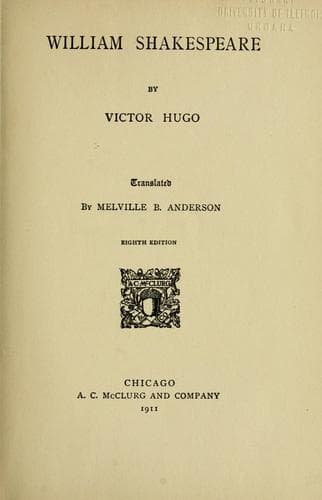
Dramatists, English -- Early modern, 1500-1700 -- Biography; Shakespeare, William, 1564-1616; Stratford-upon-Avon (England) -- Biography
One salutary reaction is the result of the combined effort of two
critics watching over public tranquillity. This reaction has already
produced some specimens of poets,--steady, well-bred, prudent, whose
style always keeps good time; who never indulge in an orgy with all
those mad things, ideas; who are never met at the corner of a wood,
_solus cum sola_, with that Bohemian, Revery; who are incapable of
having connection either with Imagination, a dangerous vagabond, or
with Inspiration, a Bacchante, or with Fancy, a _lorette_; who have
never in their life given a kiss to that beggarly chit, the Muse;
who do not sleep out, and who are honoured with the esteem of their
door-keeper, Nicholas Boileau. If Polyhymnia goes by with her hair
rather flowing, what a scandal! Quick, they call the hairdresser. M.
de la Harpe comes hastily. These two sister critics, the doctrinal and
the sacerdotal, undertake to educate. They bring up writers from the
birth. They keep houses to wean them, a boarding-school for juvenile
reputations.
Thence a discipline, a literature, an art. Dress right, fall into line!
Society must be saved in literature as well as in politics. Every one
knows that poetry is a frivolous, insignificant thing, childishly
occupied in seeking rhymes, barren, vain; therefore nothing is more
formidable. It behooves us to well secure the thinkers. Lie down,
dangerous beast! What is a poet? For honour, nothing; for persecution,
everything.
This race of writers requires repression. It is useful to have
recourse to the secular arm. The means vary. From time to time a
good banishment is expedient. The list of exiled writers opens with
Æschylus, and does not close with Voltaire. Each century has its
link in this chain. But there must be at least a pretext for exile,
banishment, and proscription. That cannot apply to all cases. It is
rather unmanageable; it is important to have a lighter weapon for
every-day skirmishing. A State criticism, duly sworn in and accredited,
can render service. To organize the persecution of writers by means of
writers is not a bad thing. To entrap the pen by the pen is ingenious.
Why not have literary policemen?
Good taste is a precaution taken by good order. Sober writers are the
counterpart of prudent electors. Inspiration is suspected of love for
liberty. Poetry is rather outside of legality; there is, therefore, an
official art, the offspring of official criticism.
Public-domain text, read in full here on John Shaqi.
Reviews
Reviews
No reviews yet
Be the first to share your thoughts on this work.
Elsewhere in the archive
Join the Discussion
Join the discussion
Sign in to leave a comment or review.
Sign InorCreate an account