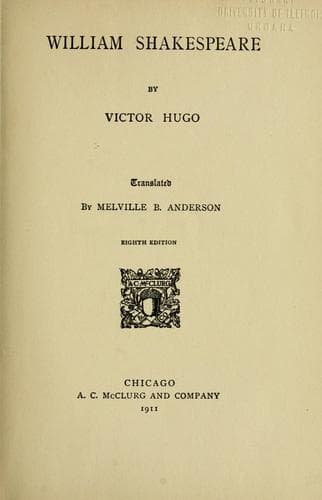
Dramatists, English -- Early modern, 1500-1700 -- Biography; Shakespeare, William, 1564-1616; Stratford-upon-Avon (England) -- Biography
Like all lofty minds in full riot of Omnipotence, Shakespeare decants
all Nature, drinks it, and makes you drink it. Voltaire reproached
him for his drunkenness, and was quite right. Why on earth, we repeat
why has this Shakespeare such a temperament? He does not stop, he
does not feel fatigue, he is without pity for the poor weak stomachs
that are candidates for the Academy. The gastritis called "good
taste," he does not labour under it. He is powerful. What is this vast
intemperate song that he sings through ages,--war-song, drinking-song,
love-ditty,--which passes from King Lear to Queen Mab, and from Hamlet
to Falstaff, heart-rending at times as a sob, grand as the Iliad? "I
have the lumbago from reading Shakespeare," said M. Auger.
His poetry has the sharp perfume of honey made by the vagabond
bee without a hive. Here prose, there verse; all forms, being but
receptacles for the idea, suit him. This poetry weeps and laughs. The
English tongue, a language little formed, now assists, now harms him,
but everywhere the deep mind gushes forth translucent Shakespeare's
drama proceeds with a kind of distracted rhythm. It is so vast that
it staggers; it has and gives the vertigo; but nothing is so solid as
this excited grandeur. Shakespeare, shuddering, has in himself the
winds, the spirits, the philters, the vibrations, the fluctuations
of transient breezes, the obscure penetration of effluvia, the great
unknown sap. Thence his agitation, in the depth of which is repose.
It is this agitation in which Goethe is wanting, wrongly praised for
his impassiveness, which is inferiority. This agitation, all minds
of the first order have it. It is in Job, in Æschylus, in Alighieri.
This agitation is humanity. On earth the divine must be human. It
must propose to itself its own enigma and feel disturbed about it.
Inspiration being prodigy, a sacred stupor mingles with it. A certain
majesty of mind resembles solitudes and is blended with astonishment.
Shakespeare, like all great poets, like all great things, is absorbed
by a dream. His own vegetation astounds him; his own tempest appals
him. It seems at times as if Shakespeare terrified Shakespeare. He
shudders at his own depth. This is the sign of supreme intellects. It
is his own vastness which shakes him and imparts to him unaccountable
huge oscillations. There is no genius without waves. An inebriated
savage it may be. He has the wildness of the virgin forest; he has the
intoxication of the high sea.
Shakespeare (the condor alone gives some idea of such gigantic gait)
departs, arrives, starts again, mounts, descends, hovers, dives, sinks,
rushes, plunges into the depths below, plunges into the depths above.
He is one of those geniuses that God purposely leaves unbridled, so
that they may go headlong and in full flight into the infinite.
From time to time comes on this globe one of these spirits. Their
passage, as we have said, renews art, science, philosophy, or society.
Public-domain text, read in full here on John Shaqi.
Reviews
Reviews
No reviews yet
Be the first to share your thoughts on this work.
Elsewhere in the archive
Join the Discussion
Join the discussion
Sign in to leave a comment or review.
Sign InorCreate an account