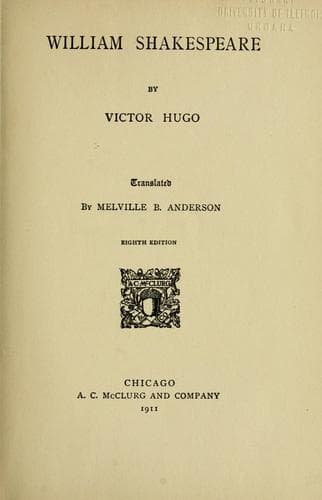
Dramatists, English -- Early modern, 1500-1700 -- Biography; Shakespeare, William, 1564-1616; Stratford-upon-Avon (England) -- Biography
They fill a century, then disappear. Then it is not one century alone
that their light illumines, it is humanity from one end to another of
time; and it is perceived that each of these men was the human mind
itself contained whole in one brain, and coming, at a given moment, to
give on earth an impetus to progress.
These supreme spirits, once life achieved and the work completed, go in
death to rejoin the mysterious group, and are probably at home in the
infinite.
BOOK II.
SHAKESPEARE.--HIS WORK.--THE CULMINATING POINTS.
CHAPTER I.
The characteristic of men of genius of the first order is to
produce each a peculiar model of man. All bestow on humanity its
portrait,--some laughing, some weeping, others pensive. These last are
the greatest. Plautus laughs, and gives to man Amphitryon; Rabelais
laughs, and gives to man Gargantua; Cervantes laughs, and gives to man
Don Quixote; Beaumarchais laughs, and gives to man Figaro; Molière
weeps, and gives to man Alceste; Shakespeare dreams, and gives to man
Hamlet; Æschylus meditates, and gives to man Prometheus. The others are
great; Æschylus and Shakespeare are immense.
These portraits of humanity, left to humanity as a last farewell by
those passers-by, the poets, are rarely flattered, always exact,
striking likenesses. Vice, or folly, or virtue, is extracted from the
soul and stamped on the visage. The tear congealed becomes a pearl;
the smile petrified ends by looking like a menace; wrinkles are the
furrows of wisdom; some frowns are tragic. This series of models of man
is the permanent lesson for generations; each century adds in some
figures,--sometimes done in full light and strong relief, like Macette,
Célimène, Tartuffe, Turcaret, and the Nephew of Rameau; sometimes
simple profiles, like Gil Bias, Manon Lescaut, Clarissa Harlowe, and
Candide.
God creates by intuition; man creates by inspiration, strengthened by
observation. This second creation, which is nothing else but divine
action carried out by man, is what is called genius.
The poet stepping into the place of destiny; an invention of men and
events so strange, so true to nature, and so masterly that certain
religious sects hold it in horror as an encroachment upon Providence,
and call the poet "the liar;" the conscience of man, taken in the act
and placed in a medium which it combats, governs or transforms,--such
is the drama. And there is in this something superior. This handling
of the human soul seems a kind of equality with God,--equality, the
mystery of which is explained when we reflect that God is within
man. This equality is identity. Who is our conscience? He. And He
counsels good acts. Who is our intelligence? He. And He inspires the
_chef-d'œuvre._
Public-domain text, read in full here on John Shaqi.
Reviews
Reviews
No reviews yet
Be the first to share your thoughts on this work.
Elsewhere in the archive
Join the Discussion
Join the discussion
Sign in to leave a comment or review.
Sign InorCreate an account