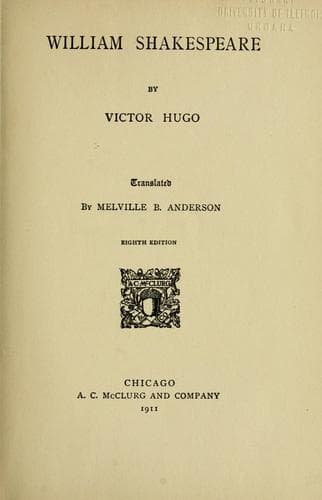
Dramatists, English -- Early modern, 1500-1700 -- Biography; Shakespeare, William, 1564-1616; Stratford-upon-Avon (England) -- Biography
We are in the habit of comparing Æschylus and Shakespeare by Orestes
and Hamlet, these two tragedies being the same drama. Never in fact was
a subject more identical. The learned mark an analogy between them; the
impotent, who are also the ignorant, the envious, who are also the
imbeciles, have the petty joy of thinking they establish a plagiarism.
It is after all a possible field for erudition and for serious
criticism. Hamlet walks behind Orestes, parricide through filial
love. This easy comparison, rather superficial than deep, strikes us
less than the mysterious confronting of those two enchained beings,
Prometheus and Hamlet.
Let us not forget that the human mind, half divine as it is, creates
from time to time superhuman works. These superhuman works of man are,
moreover, more numerous than it is thought, for they entirely fill art.
Out of poetry, where marvels abound, there is in music Beethoven, in
sculpture Phidias, in architecture Piranesi, in painting Rembrandt, and
in painting, architecture, and sculpture Michael Angelo. We pass many
over, and not the least.
Prometheus and Hamlet are among those more than human works.
A kind of gigantic determination; the usual measure exceeded; greatness
everywhere; that which astounds ordinary intellects demonstrated when
necessary by the improbable; destiny, society, law, religion, brought
to trial and judgment in the name of the Unknown, the abyss of the
mysterious equilibrium; the event treated as a _rôle_ played out, and,
on occasion, hurled as a reproach against Fatality or Providence;
passion, terrible personage, going and coming in man; the audacity and
sometimes the insolence of reason; the haughty forms of a style at ease
in all extremes, and at the same time a profound wisdom; the gentleness
of the giant; the goodness of a softened monster; an ineffable dawn
which cannot be accounted for and which lights up everything,--such are
the signs of those supreme works. In certain poems there is starlight.
This light is in Æschylus and in Shakespeare.
CHAPTER IV.
Public-domain text, read in full here on John Shaqi.
Reviews
Reviews
No reviews yet
Be the first to share your thoughts on this work.
Elsewhere in the archive
Join the Discussion
Join the discussion
Sign in to leave a comment or review.
Sign InorCreate an account