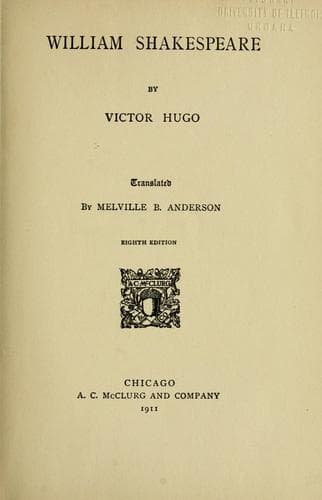
Dramatists, English -- Early modern, 1500-1700 -- Biography; Shakespeare, William, 1564-1616; Stratford-upon-Avon (England) -- Biography
As we have said before, so many types, so many Adams. The man of Homer,
Achilles, is an Adam; from him comes the species of the slayers: the
man of Æschylus, Prometheus, is an Adam; from him comes the race of the
fighters: Shakespeare's man, Hamlet, is an Adam; to him belongs the
family of the dreamers. Other Adams, created by poets, incarnate, this
one passion, another duty, another reason, another conscience, another
the fall, another the ascension. Prudence, drifting to trepidation,
goes on from the old man Nestor to the old man Géronte. Love, drifting
to appetite, goes on from Daphne to Lovelace. Beauty, entwined with the
serpent, goes from Eve to Melusina. The types begin in Genesis, and a
link of their chain passes through Restif de la Bretonne and Vadé. The
lyric suits them, Billingsgate is not unbecoming to them. They speak
in country dialects by the mouth of Gros-René; and in Homer they say
to Minerva, holding them by the hair of the head: "What dost thou want
with me, goddess?"
A surprising exception has been conceded to Dante. The man of Dante
is Dante. Dante has, so to speak, created himself a second time in
his poem. He is his own type; his Adam is himself. For the action
of his poem he has sought out no one. He has only taken Virgil as
supernumerary. Moreover, he made himself epic at once, without even
giving himself the trouble to change his name. What he had to do was
in fact simple,--to descend into hell and remount to heaven. What good
was it to trouble himself for so little? He knocks gravely at the door
of the infinite and says, "Open! I am Dante."
CHAPTER III.
Two marvellous Adams, we have just said, are the man of Æschylus,
Prometheus, and the man of Shakespeare, Hamlet.
Prometheus is action. Hamlet is hesitation.
In Prometheus the obstacle is exterior; in Hamlet it is interior.
In Prometheus the will is securely nailed down by nails of brass and
cannot get loose; besides, it has by its side two watchers,--Force
and Power. In Hamlet the will is more tied down yet; it is bound by
previous meditation,--the endless chain of the undecided. Try to get
out of yourself if you can! What a Gordian knot is our revery! Slavery
from within, that is slavery indeed. Scale this enclosure, "to dream!"
escape, if you can, from this prison, "to love!" The only dungeon is
that which walls conscience in. Prometheus, in order to be free, has
but a bronze collar to break and a god to conquer; Hamlet must break
and conquer himself. Prometheus can raise himself upright, if he
only lifts a mountain; to raise himself up, Hamlet must lift his own
thoughts. If Prometheus plucks the vulture from his breast, all is
said; Hamlet must tear Hamlet from his breast. Prometheus and Hamlet
are two naked livers; from one runs blood, from the other doubt.
Public-domain text, read in full here on John Shaqi.
Reviews
Reviews
No reviews yet
Be the first to share your thoughts on this work.
Elsewhere in the archive
Join the Discussion
Join the discussion
Sign in to leave a comment or review.
Sign InorCreate an account