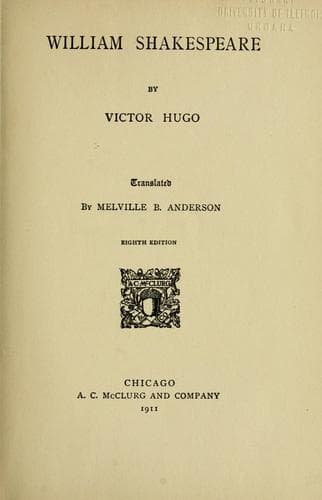
Dramatists, English -- Early modern, 1500-1700 -- Biography; Shakespeare, William, 1564-1616; Stratford-upon-Avon (England) -- Biography
will become of us? And in the vast whole of created beings, things,
men, animals, plants, rocks, all turned toward the Caucasus, is felt
this inexpressible anguish,--the liberator is enchained.
Hamlet, less of a giant and more of a man, is not less grand,--Hamlet,
the appalling, the unaccountable, complete in incompleteness; all,
in order to be nothing. He is prince and demagogue, sagacious and
extravagant, profound and frivolous, man and neuter. He has but
little faith in the sceptre, rails at the throne, has a student for
his comrade, converses with any one passing by, argues with the first
comer, understands the people, despises the mob, hates strength,
suspects success, questions obscurity, and says "thou" to mystery. He
gives to others maladies which he has not himself: his false madness
inoculates his mistress with true madness. He is familiar with spectres
and with comedians. He jests with the axe of Orestes in his hand. He
talks of literature, recites verses, composes a theatrical criticism,
plays with bones in a cemetery, dumbfounds his mother, avenges his
father, and ends the wonderful drama of life and death by a gigantic
point of interrogation. He terrifies and then disconcerts. Never has
anything more overwhelming been dreamed. It is the parricide saying:
"What do I know?"
Parricide? Let us pause on that word. Is Hamlet a parricide? Yes, and
no. He confines himself to threatening his mother; but the threat is so
fierce that the mother shudders. His words are like daggers. "What wilt
thou do? Thou wilt not murder me? Help! help! ho!" And when she dies,
Hamlet, without grieving for her, strikes Claudius with this tragic
cry: "Follow my mother!" Hamlet is that sinister thing, the possible
parricide.
In place of the northern ice which he has in his nature, let him have,
like Orestes, southern fire in his veins, and he will kill his mother.
This drama is stern. In it truth doubts, sincerity lies. Nothing can
be more immense, more subtile. In it man is the world, and the world
is zero. Hamlet, even full of life, is not sure of his existence.
In this tragedy, which is at the same time a philosophy, everything
floats, hesitates, delays, staggers, becomes discomposed, scatters,
and is dispersed. Thought is a cloud, will is a vapour, resolution is
a crepuscule; the action blows each moment in an opposite direction;
man is governed by the winds. Overwhelming and vertiginous work, in
which is seen the depth of everything, in which thought oscillates only
between the king murdered and Yorick buried, and in which what is best
realized is royalty represented by a ghost, and mirth represented by a
death's-head.
"Hamlet" is the _chef-d'œuvre_ of the tragedy-dream.
CHAPTER V.
Public-domain text, read in full here on John Shaqi.
Reviews
Reviews
No reviews yet
Be the first to share your thoughts on this work.
Elsewhere in the archive
Join the Discussion
Join the discussion
Sign in to leave a comment or review.
Sign InorCreate an account