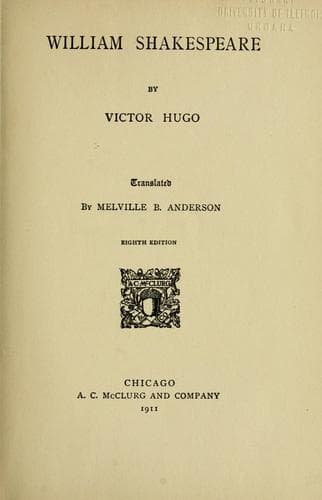
Dramatists, English -- Early modern, 1500-1700 -- Biography; Shakespeare, William, 1564-1616; Stratford-upon-Avon (England) -- Biography
One of the probable causes of the feigned madness of Hamlet has not
been up to the present time indicated by critics. It has been said,
"Hamlet acts the madman to hide his thought, like Brutus." In fact, it
is easy for apparent imbecility to hatch a great project; the supposed
idiot can take aim deliberately. But the case of Brutus is not that
of Hamlet. Hamlet acts the madman for his safety. Brutus screens his
project, Hamlet his person. The manners of those tragic courts being
known, from the moment that Hamlet, through the revelation of the
ghost, is acquainted with the crime of Claudius, Hamlet is in danger.
The superior historian within the poet is here manifested, and one
feels the deep insight of Shakespeare into the ancient darkness of
royalty. In the Middle Ages and in the Lower Empire, and even at
earlier periods, woe unto him who found out a murder or a poisoning
committed by a king! Ovid, according to Voltaire's conjecture, was
exiled from Rome for having seen something shameful in the house of
Augustus. To know that the king was an assassin was a State crime.
When it pleased the prince not to have had a witness, it was a matter
involving one's head to ignore everything. It was bad policy to have
good eyes. A man suspected of suspicion was lost. He had but one
refuge,--folly; to pass for "an innocent" He was despised, and that was
all. Do you remember the advice that, in Æschylus, the Ocean gives to
Prometheus: "To look a fool is the secret of the wise man." When the
Chamberlain Hugolin found the iron spit with which Edrick the Vendee
had empaled Edmond II., "he hastened to put on madness," says the Saxon
Chronicle of 1016, and saved himself in that way. Heraclian of Nisibe,
having discovered by chance that Rhinomete was a fratricide, had
himself declared mad by the doctors, and succeeded in getting himself
shut up for life in a cloister. He thus lived peaceably, growing old
and waiting for death with a vacant stare. Hamlet runs the same peril,
and has recourse to the same means. He gets himself declared mad like
Heraclian, and puts on folly like Hugolin. This does not prevent the
restless Claudius from twice making an effort to get rid of him,--in
the middle of the drama by the axe or the dagger in England, and toward
the conclusion by poison.
The same indication is again found in "King Lear;" the Earl of
Gloster's son takes refuge also in apparent lunacy. There is in that a
key to open and understand Shakespeare's thought. In the eyes of the
philosophy of art, the feigned folly of Edgar throws light upon the
feigned folly of Hamlet.
Public-domain text, read in full here on John Shaqi.
Reviews
Reviews
No reviews yet
Be the first to share your thoughts on this work.
Elsewhere in the archive
Join the Discussion
Join the discussion
Sign in to leave a comment or review.
Sign InorCreate an account