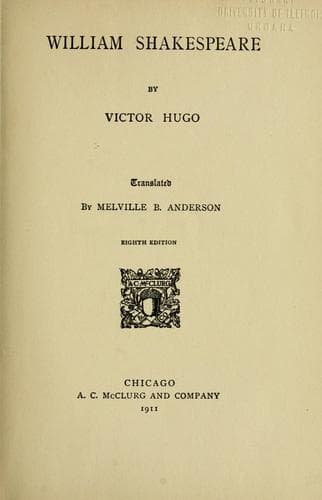
Dramatists, English -- Early modern, 1500-1700 -- Biography; Shakespeare, William, 1564-1616; Stratford-upon-Avon (England) -- Biography
He is tormented by that possible life, intermixed with reality and
chimera, the anxiety of which is shared by all of us. There is in
all his actions an expanded somnambulism. One might almost consider
his brain as a formation; there is a layer of suffering, a layer of
thought, then a layer of dreaminess. It is through this layer of
dreaminess that he feels, comprehends, learns, perceives, drinks, eats,
frets, mocks, weeps, and reasons. There is between life and him a
transparency; it is the wall of dreams. One sees beyond, but one cannot
step over it. A kind of cloudy obstacle everywhere surrounds Hamlet.
Have you ever while sleeping, had the nightmare of pursuit or flight,
and tried to hasten on, and felt anchylosis in the knees, heaviness in
the arms, the horror of paralysed hands, the impossibility of movement?
This nightmare Hamlet undergoes while waking. Hamlet is not upon the
spot where his life is. He has ever the appearance of a man who talks
to you from the other side of a stream. He calls to you at the same
time that he questions you. He is at a distance from the catastrophe in
which he takes part, from the passer-by whom he interrogates, from the
thought that he carries, from the action that he performs. He seems not
to touch even what he grinds. It is isolation in its highest degree. It
is the loneliness of a mind, even more than the loftiness of a prince.
Indecision is in fact a solitude. You have not even your will to keep
you company. It is as if your own self was absent and had left you
there. The burden of Hamlet is less rigid than that of Orestes, but
more undulating. Orestes carries predestination; Hamlet carries fate.
And thus apart from men, Hamlet has still in him a something which
represents them all. _Agnosco fratrem._ At certain hours, if we felt
our own pulse, we should be conscious of his fever. His strange reality
is our own reality after alL He is the mournful man that we all are in
certain situations. Unhealthy as he is, Hamlet expresses a permanent
condition of man. He represents the discomfort of the soul in a life
which is not sufficiently adapted to it He represents the shoe that
pinches and stops our walking; the shoe is the body. Shakespeare
frees him from it, and he is right Hamlet--prince if you like, but
king never--Hamlet is incapable of governing a people; he lives too
much in a world beyond. On the other hand, he does better than to
reign; he _is._ Take from him his family, his country, his ghost, and
the whole adventure at Elsinore, and even in the form of an inactive
type, he remains strangely terrible. That is the consequence of the
amount of humanity and the amount of mystery that is in him. Hamlet is
formidable, which does not prevent his being ironical. He has the two
profiles of destiny.
Public-domain text, read in full here on John Shaqi.
Reviews
Reviews
No reviews yet
Be the first to share your thoughts on this work.
Elsewhere in the archive
Join the Discussion
Join the discussion
Sign in to leave a comment or review.
Sign InorCreate an account