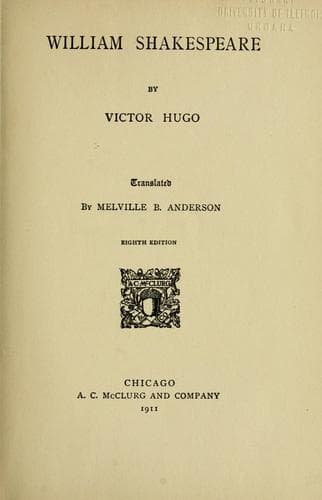
Dramatists, English -- Early modern, 1500-1700 -- Biography; Shakespeare, William, 1564-1616; Stratford-upon-Avon (England) -- Biography
The Amleth of Belleforest is a magician; the Hamlet of Shakespeare
is a philosopher. We just now spoke of the strange reality which
characterizes poetical creations. There is no more striking example
than this type,--Hamlet. Hamlet has nothing belonging to an abstraction
about him. He has been at the University; he has the Danish rudeness
softened by Italian politeness; he is small, plump, somewhat
lymphatic; he fences well with the sword, but is soon out of breath.
He does not care to drink too soon during the assault of arms with
Laërtes,--probably for fear of producing perspiration. After having
thus supplied his personage with real life, the poet can launch him
into full ideal. There is ballast enough.
Other works of the human mind equal "Hamlet;" none surpasses it. The
whole majesty of melancholy is in "Hamlet." An open sepulchre from
which goes forth a drama,--this is colossal "Hamlet" is to our mind
Shakespeare's chief work.
No figure among those that poets have created is more poignant and
stirring. Doubt counselled by a ghost,--that is Hamlet. Hamlet has
seen his dead father and has spoken to him. Is he convinced? No, he
shakes his head. What shall he do? He does not know. His hands clench,
then fall by his side. Within him are conjectures, systems, monstrous
apparitions, bloody recollections, veneration for the spectre, hate,
tenderness, anxiety to act and not to act, his father, his mother,
his duties in contradiction to each other,--a deep storm. Livid
hesitation is in his mind. Shakespeare, wonderful plastic poet, makes
the grandiose pallor of this soul almost visible. Like the great larva
of Albert Dürer, Hamlet might be named "Melancholia." He also has above
his head the bat which flies disembowelled; and at his feet science,
the sphere, the compass, the hour-glass, love; and behind him in the
horizon an enormous, terrible sun, which seems to make the sky but
darker.
Nevertheless, at least one half of Hamlet is anger, transport, outrage,
hurricane, sarcasm to Ophelia, malediction on his mother, insult to
himself. He talks with the gravediggers, nearly laughs, then clutches
Laërtes by the hair in the very grave of Ophelia, and stamps furiously
upon the coffin. Sword-thrusts at Polonius, sword-thrusts at Laërtes,
sword-thrusts at Claudius. From time to time his inaction is tom in
twain, and from the rent comes forth thunder.
Public-domain text, read in full here on John Shaqi.
Reviews
Reviews
No reviews yet
Be the first to share your thoughts on this work.
Elsewhere in the archive
Join the Discussion
Join the discussion
Sign in to leave a comment or review.
Sign InorCreate an account