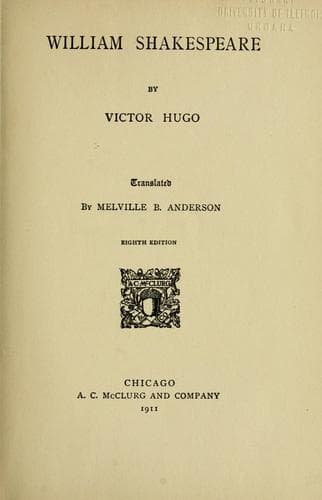
Dramatists, English -- Early modern, 1500-1700 -- Biography; Shakespeare, William, 1564-1616; Stratford-upon-Avon (England) -- Biography
Covetousness easily becoming violence, violence easily becoming
crime, crime easily becoming madness,--this progression is Macbeth.
Covetousness, crime, madness,--these three vampires have spoken to him
in the solitude, and have invited him to the throne. The cat Graymalkin
has called him: Macbeth will be cunning. The toad Paddock has called
him: Macbeth will be horror. The _unsexed_ being, Gruoch, completes
him. It is done; Macbeth is no longer a man. He is nothing more than
an unconscious energy rushing wildly toward evil. Henceforth, no
notion of right; appetite is everything. Transitory right, royalty;
eternal right, hospitality,--Macbeth murders them all. He does more
than slay them,--he ignores them. Before they fell bleeding under
his hand, they already lay dead within his soul. Macbeth commences
by this parricide,--the murder of Duncan, his guest; a crime so
terrible that from the counter-blow in the night, when their master
is stabbed, the horses of Duncan again become wild. The first step
taken, the fall begins. It is the avalanche. Macbeth rolls headlong.
He is precipitated. He falls and rebounds from one crime to another,
always deeper and deeper. He undergoes the mournful gravitation of
matter invading the soul. He is a thing that destroys. He is a stone
of ruin, flame of war, beast of prey, scourge. He marches over all
Scotland, king as he is, his bare legged kernes and his heavily-armed
gallowglasses, devouring, pillaging, slaying. He decimates the Thanes,
he kills Banquo, he kills all the Macduffs except the one who shall
slay him, he kills the nobility, he kills the people, he kills his
country, he kills "sleep." At length the catastrophe arrives,--the
forest of Birnam moves against him. Macbeth has infringed all, burst
through everything, violated everything, torn everything, and this
desperation ends in arousing even Nature. Nature loses patience, Nature
enters into action against Macbeth, Nature becomes soul against the man
who has become brute force.
This drama has epic proportions. Macbeth represents that frightful
hungry one who prowls throughout history, called brigand in the forest
and on the throne conqueror. The ancestor of Macbeth is Nimrod. These
men of force, are they forever furious? Let us be just; no. They have a
goal, which being attained, they stop. Give to Alexander, to Cyrus, to
Sesostris, to Cæsar, what?--the world; they are appeased. Geoffroy St.
Hilaire said to me one day: "When the lion has eaten, he is at peace
with Nature." For Cambyses, Sennacherib, and Genghis Khan, and their
parallels, to have eaten is to possess all the earth. They would calm
themselves down in the process of digesting the human race.
Public-domain text, read in full here on John Shaqi.
Reviews
Reviews
No reviews yet
Be the first to share your thoughts on this work.
Elsewhere in the archive
Join the Discussion
Join the discussion
Sign in to leave a comment or review.
Sign InorCreate an account