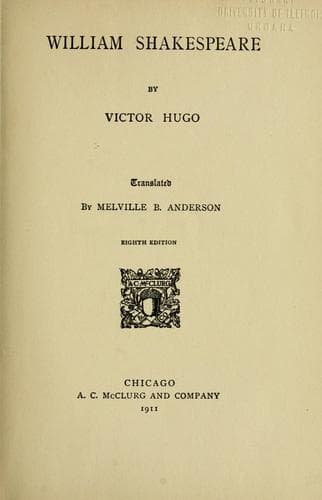
Dramatists, English -- Early modern, 1500-1700 -- Biography; Shakespeare, William, 1564-1616; Stratford-upon-Avon (England) -- Biography
Now, what is Othello? He is night; an immense fatal figure. Night is
amorous of day. Darkness loves the dawn. The African adores the white
woman. Desdemona is Othello's brightness and frenzy! And then how easy
to him is jealousy! He is great, he is dignified, he is majestic, he
soars above all heads, he has as an escort bravery, battle, the braying
of trumpets, the banner of war, renown, glory; he is radiant with
twenty victories, he is studded with stars, this Othello: but he is
black. And thus how soon, when jealous, the hero becomes monster, the
black becomes the negro! How speedily has night beckoned to death!
By the side of Othello, who is night, there is Iago, who is
evil,--evil, the other form of darkness. Night is but the night of the
world; evil is the night of the soul. How deeply black are perfidy
and falsehood! To have ink or treason in the veins is the same thing.
Whoever has jostled against imposture and perjury knows it. One must
blindly grope one's way with roguery. Pour hypocrisy upon the break
of day, and you put out the sun; and this, thanks to false religions,
happens to God.
Iago near Othello is the precipice near the landslip. "This way!"
he says in a low voice. The snare advises blindness. The being of
darkness guides the black. Deceit takes upon itself to give what
light may be required by night. Jealousy uses falsehood as the
blind man his dog. Othello the negro, Iago the traitor, opposed to
whiteness and candour,--what can be more terrible! These ferocities
of the darkness act in unison. These two incarnations of the eclipse
conspire together,--the one roaring, the other sneering; the tragic
extinguishment of light.
Sound this profound thing. Othello is the night, and being night, and
wishing to kill, what does he take to slay with? Poison, the club,
the axe, the knife? No; the pillow. To kill is to lull to sleep.
Shakespeare himself perhaps did not take this into account. The creator
sometimes, almost unknown to himself, yields to his type, so much is
that type a power. And it is thus that Desdemona, spouse of the man
Night, dies stifled by the pillow, which has had the first kiss, and
which has the last sigh.
Lear is the occasion for Cordelia. Maternity of the daughter toward
the father,--profound subject; maternity venerable among all other
maternities, so admirably translated by the legend of that Roman girl,
who, in the depth of a prison, nurses her old father. The young breast
near the white beard,--there is not a spectacle more holy. This filial
breast is Cordelia.
Public-domain text, read in full here on John Shaqi.
Reviews
Reviews
No reviews yet
Be the first to share your thoughts on this work.
Elsewhere in the archive
Join the Discussion
Join the discussion
Sign in to leave a comment or review.
Sign InorCreate an account