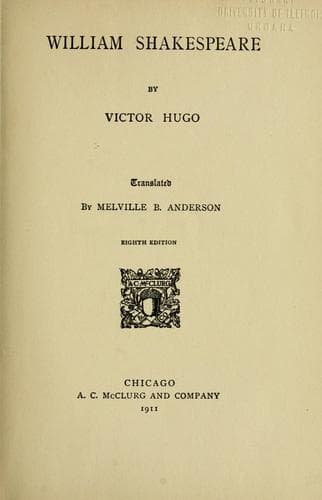
Dramatists, English -- Early modern, 1500-1700 -- Biography; Shakespeare, William, 1564-1616; Stratford-upon-Avon (England) -- Biography
Cordelia approaches.--"Sir, do you know me?" "You are a spirit,
I know," replies the old man, with the sublime clairvoyance of
bewilderment. From this moment the adorable nursing commences. Cordelia
applies herself to nourish this old despairing soul, dying of inanition
in hatred. Cordelia nourishes Lear with love, and his courage revives;
she nourishes him with respect, and the smile returns; she nourishes
him with hope, and confidence is restored; she nourishes him with
wisdom, and reason revives. Lear, convalescent, rises again, and, step
by step, returns again to life. The child becomes again an old man;
the old man becomes a man again. And behold him happy, this wretched
one. It is on this expansion of happiness that the catastrophe is
hurled down. Alas! there are traitors, there are perjurers, there are
murderers. Cordelia dies. Nothing more heart-rending than this. The
old man is stunned; he no longer understands anything; and embracing
the corpse, he expires. He dies on this dead one. The supreme anguish
is spared him of remaining behind her among the living, a poor shadow,
to feel the place in his heart empty and to seek for his soul, carried
away by that sweet being who is departed. O God, those whom thou lovest
thou dost not allow to survive.
To live after the flight of the angel; to be the father orphaned of
his child; to be the eye which no longer has light; to be the deadened
heart which has no more joy; from time to time to stretch the hands
into obscurity, and try to reclasp a being who was there (where, then,
can she be?); to feel himself forgotten in that departure; to have lost
all reason for being here below; to be henceforth a man who goes to
and fro before a sepulchre, not received, not admitted,--that would be
indeed a gloomy destiny. Thou hast done well, poet, to kill this old
man.
BOOK III.
ZOILUS AS ETERNAL AS HOMER.
CHAPTER I.
"Ce courtisan grossier du profane vulgaire."[1]
This Alexandrine is by La Harpe, who hurls it at Shakespeare. Somewhere
else La Harpe says, "Shakespeare panders to the mob."
Voltaire, as a matter of course, reproaches Shakespeare with
antithesis: that is well. And La Beaumelle reproaches Voltaire with
antithesis: that is better.
Voltaire, when he is himself in question, _pro domo sua_, gets angry.
"But," he writes, "this Langleviel, alias La Beaumelle, is an ass. I
defy you to find in any poet, in any book, a fine thing which is not an
image or an antithesis."
Voltaire's criticism is double-edged. He wounds and is wounded. This is
how he characterizes the Ecclesiastes and the Canticle of Canticles:
"Works without order, full of low images and coarse expressions."
A little while after, furious, he exclaims,--
"On m'ose préférer Crébillon le barbare!"[2]
An idler of the Œil-de-Bœuf, wearing the red heel and the blue
ribbon, a stripling and a marquis,--M. de Créqui,--comes to Ferney,
and writes with an air of superiority: "I have seen Voltaire, that
childish old man."
Public-domain text, read in full here on John Shaqi.
Reviews
Reviews
No reviews yet
Be the first to share your thoughts on this work.
Elsewhere in the archive
Join the Discussion
Join the discussion
Sign in to leave a comment or review.
Sign InorCreate an account