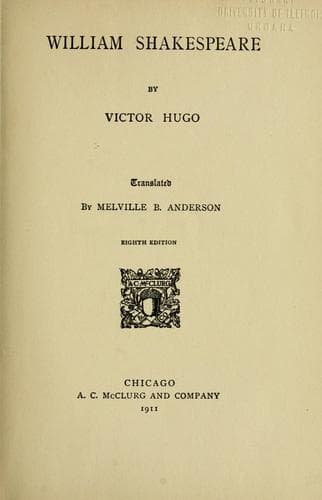
Dramatists, English -- Early modern, 1500-1700 -- Biography; Shakespeare, William, 1564-1616; Stratford-upon-Avon (England) -- Biography
this foundation established, he takes everything and builds his work.
Unheard of edifice. He takes tyranny, of which, at a later period,
he will make weakness,--Lear; he takes treason,--Edmond; he takes
devotion,--Kent; he takes ingratitude which begins with a caress, and
he gives to this monster two heads,--Goneril, whom the legend calls
Gornerille, and Regan, whom the legend calls Ragaü; he takes paternity;
he takes royalty; he takes feudality; he takes ambition; he takes
madness, which he divides into three, and he puts in presence three
madmen,--the king's buffoon, madman by trade; Edgar of Gloster, mad for
prudence's sake; the king mad through misery. It is at the summit of
this tragic heap that he raises Cordelia.
There are some formidable cathedral towers, like, for instance, the
Giralda of Seville, which seem made all complete, with their spirals,
their staircases, their sculptures, their cellars, their cœcums, their
aerial cells, their sounding chambers, their bells, and their mass
and their spire, and all their enormity, in order to carry an angel
spreading on their summit her golden wings. Such is this drama, "King
Lear."
The father is the pretext for the daughter. This admirable human
creation, Lear, serves as a support to that ineffable divine creation,
Cordelia. The reason why that chaos of crimes, vices, madnesses, and
miseries exists is, for the more splendid setting forth of virtue.
Shakespeare, carrying Cordelia in his thoughts, created that tragedy
like a god who, having an Aurora to put forward, makes a world
expressly for it.
And what a figure is that father! What a caryatid! He is man bent down
by weight, but shifts his burdens for others that are heavier. The more
the old man becomes enfeebled, the more his load augments. He lives
under an overburden. He bears at first power, then ingratitude, then
isolation, then despair, then hunger and thirst, then madness, then all
Nature. Clouds overcast him, forests heap shadow on him, the hurricane
beats on the nape of his neck, the tempest makes his mantle heavy as
lead, the rain falls on his shoulders, he walks bent and haggard as if
he had the two knees of night upon his back. Dismayed and yet immense,
he throws to the winds and to the hail this epic cry: "Why do you hate
me, tempests? Why do you persecute me? _You are not my daughters._"
And then it is over; the light is extinguished,--reason loses courage
and leaves him. Lear is in his dotage. Ah, he is childish, this old
man. Very well! he requires a mother. His daughter appears,--his one
daughter Cordelia; for the two others Regan and Goneril, are no longer
his daughters, save to that extent which gives them a right to the name
of parricides.
Public-domain text, read in full here on John Shaqi.
Reviews
Reviews
No reviews yet
Be the first to share your thoughts on this work.
Elsewhere in the archive
Join the Discussion
Join the discussion
Sign in to leave a comment or review.
Sign InorCreate an account