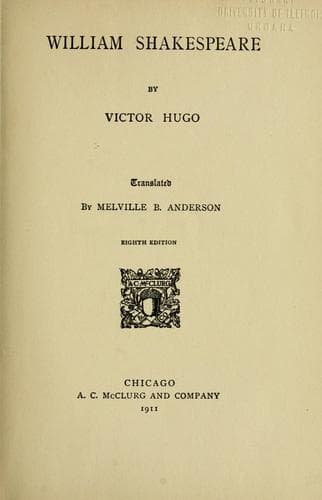
Dramatists, English -- Early modern, 1500-1700 -- Biography; Shakespeare, William, 1564-1616; Stratford-upon-Avon (England) -- Biography
Voltaire is the most hated, being the greatest. Everything was good for
an attack on him, everything was a pretext: Mesdames de France, Newton,
Madame du Châtelet, the Princess of Prussia, Maupertuis, Frederic, the
Encyclopædia, the Academy, even Labarre, Sirven, and Calas,--never
a truce. His popularity suggested to Joseph de Maistre this: "Paris
crowned him; Sodom would have banished him." Arouet was translated into
_A rouer._[1] At the house of the Abbess of Nivelles, Princess of the
Holy Empire, half recluse and half worldling, and having recourse, it
is said, in order to make her cheeks rosy, to the method of the Abbess
of Montbazon, charades were played,--among others, this one: The first
syllable is his fortune; the second should be his duty. The word
was _Vol-taire._[2] A celebrated member of the Academy of Sciences,
Napoleon Bonaparte, seeing in 1803, in the library of the Institute,
in the centre of a crown of laurels, this inscription: "Au grand
Voltaire," scratched with his nail the last three letters, leaving
only, _Au grand Volta!_
There is round Voltaire particularly a _cordon sanitaire_ of priests,
the Abbé Desfontaines at the head, the Abbé Nicolardot at the tail.
Fréron, although a layman, is a critic after the priestly fashion, and
belongs to this band.
Voltaire made his first appearance at the Bastille. His cell was next
to the dungeon in which had died Bernard Palissy. Young, he tasted the
prison; old, exile. He was kept twenty-seven years away from Paris.
Jean-Jacques, wild and rather surly, was tormented in consequence of
those traits in his nature. Paris issued a writ against his person;
Geneva expelled him; Neufchâtel rejected him; Motiers-Travers damned
him; Bienne stoned him; Berne gave him the choice between prison and
expulsion; London, hospitable London, scoffed at him.
Both died, following closely on each other. Death caused no
interruption to the outrages. A man is dead; insult does not slacken
pursuit for such a trifle. Hatred can feast on a corpse. Libels
continued, falling furiously on these glories.
The Revolution came and sent them to the Pantheon.
At the beginning of this century, children were often brought to see
these two graves. They were told, "It is here." That made a strong
impression on their minds. They carried forever in their thoughts that
apparition of two sepulchres side by side,--the elliptical arch of the
vault; the antique form of the two monuments provisionally covered with
wood painted like marble; these two names, Rousseau, Voltaire, in the
twilight; and the arm carrying a flambeau which was thrust out of the
tomb of Jean-Jacques.
Louis XVIII. returned. The restoration of the Stuarts had torn Cromwell
from his grave; the restoration of the Bourbons could not do less for
Voltaire.
Public-domain text, read in full here on John Shaqi.
Reviews
Reviews
No reviews yet
Be the first to share your thoughts on this work.
Elsewhere in the archive
Join the Discussion
Join the discussion
Sign in to leave a comment or review.
Sign InorCreate an account