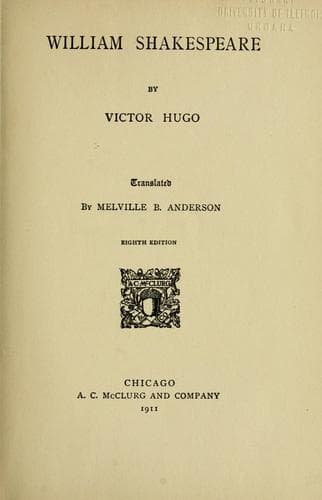
Dramatists, English -- Early modern, 1500-1700 -- Biography; Shakespeare, William, 1564-1616; Stratford-upon-Avon (England) -- Biography
One night, in May, 1814, about two o'clock in the morning, a cab
stopped near the barrier of La Gare, which faces Bercy, at the door of
an enclosure of planks. This enclosure surrounded a large vacant piece
of ground, reserved for the projected _entrepôt_, and belonging to the
city of Paris. The cab was coming from the Pantheon, and the coachman
had been ordered to take the most deserted streets. The closed planking
opened. Some men alighted from the cab and entered the enclosure. Two
carried a sack between them. They were conducted, so tradition asserts,
by the Marquis of Puymaurin, afterward deputy to the Invisible Chamber,
and director of the mint, accompanied by his brother, the Comte de
Puymaurin. Other men, many in cassocks, were waiting for them. They
proceeded toward a hole dug in the middle of the field. This hole,
according to one of the witnesses, who since has been waiter at the
inn of the Marronniers at La Rapée, was round, and looked like a blind
well. At the bottom of the hole was quicklime. These men said nothing,
and had no light. The wan break of day gave a ghastly light. The sack
was opened. It was full of bones. These were, pell-mell, the bones
of Jean Jacques and of Voltaire, which had just been withdrawn from
the Pantheon. The mouth of the sack was brought close to the hole,
and the bones were thrown into that darkness. The two skulls struck
against each other; a spark, not likely to be seen by such men as those
present was doubtless exchanged between the head that had made the
"Dictionnaire Philosophique" and the head which had made the "Contrat
Social," and reconciled them. When that was done, when the sack had
been shaken, when Voltaire and Rousseau had been emptied into that
hole, a digger seized a spade, threw inside the opening all the earth
which was at the side, and filled tip the hole; the others stamped
with their feet on the ground, so as to remove from it the appearance
of having been freshly disturbed. One of the assistants took for his
trouble the sack, as the hangman takes the clothing of his victim;
they all left the enclosure, closed the door, got into the cab without
saying a word, and hastily, before the sun had risen, those men got
away.
[Footnote 1: Deserving of being broken on the wheel.]
[Footnote 2: _Vol_ meaning _theft_, _taire_ meaning to be silent.]
CHAPTER IV.
Saumaise, that worse Scaliger, does not comprehend Æschylus, and
rejects him. Who is to blame? Saumaise much, Æschylus little.
Public-domain text, read in full here on John Shaqi.
Reviews
Reviews
No reviews yet
Be the first to share your thoughts on this work.
Elsewhere in the archive
Join the Discussion
Join the discussion
Sign in to leave a comment or review.
Sign InorCreate an account