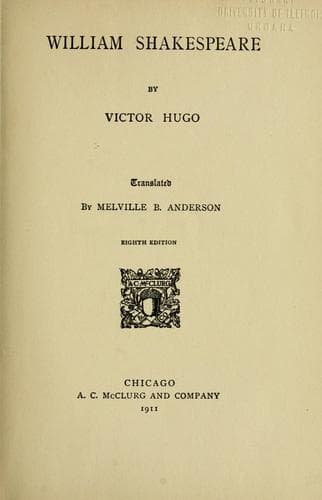
Dramatists, English -- Early modern, 1500-1700 -- Biography; Shakespeare, William, 1564-1616; Stratford-upon-Avon (England) -- Biography
After all, let us admit it at last, and complete our statement; there
is some truth in the reproaches that are hurled at them. This anger
is natural. The powerful, the grand, the luminous, are in a certain
point of view things calculated to offend. To be surpassed is never
agreeable; to feel one's own inferiority leads surely to feel offence.
The beautiful exists so truly by itself that it certainly has no
need of pride; nevertheless, given human mediocrity, the beautiful
humiliates at the same time that it enchants. It seems natural that
beauty should be a vase for pride,--it is supposed to be full of it;
one seeks to avenge one's self for the pleasure it gives, and this word
superb ends by having two senses,--one of which causes suspicion of
the other. It is the fault of the beautiful, as we have already said.
It wearies: a sketch by Piranesi bewilders you; a grasp of the hand
of Hercules bruises you. Greatness is sometimes in the wrong. It is
ingenuous, but obstructive. The tempest thinks to sprinkle you,--it
drowns you; the star thinks to give light,--it dazzles, sometimes
blinds. The Nile fertilizes, but overflows. The "too much" is not
convenient; the habitation of the fathomless is rude; the infinite
is little suitable for a lodging. A cottage is badly situated on the
cataract of Niagara or in the circus of Gavarnie. It is awkward to keep
house with these fierce wonders; to frequent them regularly without
being overwhelmed, one must be a cretin or a genius.
The dawn itself at times seems to us immoderate: he who looks at it
straight suffers. The eye at certain moments thinks very ill of the
sun. Let us not then be astonished at the complaints made, at the
incessant objections, at the fits of passion and prudence, at the
cataplasms applied by a certain criticism, at the ophthalmies habitual
to academies and teaching bodies, at the warnings given to the reader,
at all the curtains let down, and at all the shades used against
genius. Genius is intolerant without knowing it, because it is itself.
How can people be familiar with Æschylus, with Ezekiel, with Dante?
The _I_ is the right to egotism. Now, the first thing that those
beings do, is to use roughly the _I_ of each one. Exorbitant in
everything,--in thoughts, in images, in convictions, in emotions, in
passions, in faith,--whatever may be the side of your _I_ to which they
address themselves, they inconvenience it. Your intellect, they surpass
it; your imagination, they dazzle it; your conscience, they question
and search it; your bowels, they twist them; your heart, they break it;
your soul, they carry it off.
Public-domain text, read in full here on John Shaqi.
Reviews
Reviews
No reviews yet
Be the first to share your thoughts on this work.
Elsewhere in the archive
Join the Discussion
Join the discussion
Sign in to leave a comment or review.
Sign InorCreate an account