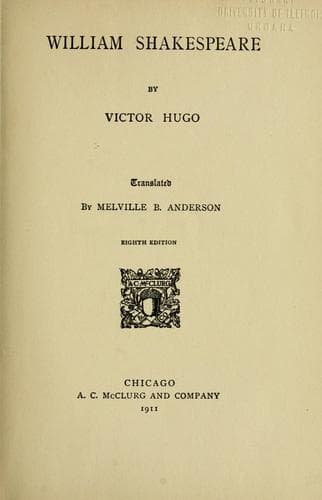
Dramatists, English -- Early modern, 1500-1700 -- Biography; Shakespeare, William, 1564-1616; Stratford-upon-Avon (England) -- Biography
been, it is true, epochs when people thought otherwise. In those times
the things which were trodden on would sometimes resent it, and would
rebel,--but that was the ancient system, ridiculous now; and those who
regret and grumble must be left to talk and to affirm that there was
a better notion of right, justice, and honour in the stones of olden
times than in the men of to-day.
The rhetoricians, official and officious,--we have pointed out already
their wonderful sagacity,--take strong precautions against men of
genius. Men of genius are not great followers of the university; what
is more, they are wanting in insipidity. They are lyrists, colourists,
enthusiasts, enchanters, possessed, exalted, "rabid" (we have read the
word) beings who, when everybody is small, have a mania for creating
great things; in fact, they have every vice. A doctor has recently
discovered that genius is a variety of madness. They are Michael Angelo
handling giants; Rembrandt painting with a palette all bedaubed with
the sun's rays; they are Dante, Rabelais, Shakespeare, exaggerated.
They bring a wild art, roaring, flaming, dishevelled like the lion and
the comet. Oh, shocking! There is coalition against them, and it is
right. We have, luckily, the "teetotallers" of eloquence and poetry.
"I like paleness," said one day a literary _bourgeois._ The literary
_bourgeois_ exists. Rhetoricians, anxious on account of the contagions
and fevers which are spread by genius, recommend with a lofty reason,
which we have commended, temperance, moderation, "common-sense," the
art of keeping within bounds, writers expurgated, trimmed, pruned,
regulated, the worship of the qualities that the malignant call
negative, continence, abstinence, Joseph, Scipio, the water-drinkers.
It is all excellent,--only, young students must be warned that by
following these sage precepts too closely they run the risk of
glorifying the chastity of the eunuch. Maybe, I admire Bayard; I admire
Origen less.
CHAPTER VI.
Résumé: Great minds are importunate; to deny them a little is judicious.
Public-domain text, read in full here on John Shaqi.
Reviews
Reviews
No reviews yet
Be the first to share your thoughts on this work.
Elsewhere in the archive
Join the Discussion
Join the discussion
Sign in to leave a comment or review.
Sign InorCreate an account