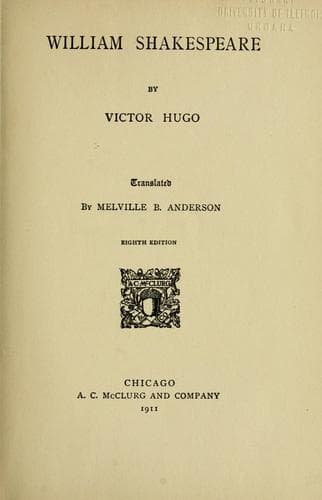
Dramatists, English -- Early modern, 1500-1700 -- Biography; Shakespeare, William, 1564-1616; Stratford-upon-Avon (England) -- Biography
the dawn and of the dew better than all your prairies and all your
hillocks can do it, although it is their natural business. The April
of the plain is flat and vulgar compared with their April; and they
have, those immense old mountains, in their wildest ravine, their own
charming spring, well known to the bees.
BOOK IV.
CRITICISM.
CHAPTER I.
Every play of Shakespeare's, two excepted, "Macbeth" and "Romeo
and Juliet" (thirty-four plays out of thirty-six), offers to our
observation one peculiarity which seems to have escaped, up to this
day, the most eminent commentators and critics,--one that the Schlegels
and M. Villemain himself, in his remarkable labours, do not notice,
and on which it is impossible not to give an opinion. It is a double
action which traverses the drama, and reflects it on a small scale.
By the side of the storm in the Atlantic, the storm in the tea-cup.
Thus, Hamlet makes beneath himself a Hamlet: he kills Polonius,
father of Laërtes,--and there is Laërtes opposite him exactly in the
same situation as he is toward Claudius. There are two fathers to
avenge. There might be two ghosts. So, in King Lear: side by side and
simultaneously, Lear, driven to despair by his daughters Goneril and
Regan, and consoled by his daughter Cordelia, is reflected by Gloster,
betrayed by his son Edmond, and loved by his son Edgar. The bifurcated
idea, the idea echoing itself, a lesser drama copying and elbowing the
principal drama, the action trailing its own shadow (a smaller action
but its parallel), the unity cut asunder,--surely it is a strange fact.
These twin actions have been strongly blamed by the few commentators
who have pointed them out. We do not participate in their blame. Do
we then approve and accept as good these twin actions? By no means.
We recognize them, and that is all. The drama of Shakespeare (we said
so with all our might as far back as 1827,[1] in order to discourage
all imitation),--the drama of Shakespeare is peculiar to Shakespeare.
It is a drama inherent to this poet; it is his own essence; it is
himself,--thence his originalities absolutely personal; thence his
idiosyncrasies which exist without establishing a law.
These twin actions are purely Shakespearian. Neither Æschylus nor
Molière would admit them; and we certainly would agree with Æschylus
and Molière.
Public-domain text, read in full here on John Shaqi.
Reviews
Reviews
No reviews yet
Be the first to share your thoughts on this work.
Elsewhere in the archive
Join the Discussion
Join the discussion
Sign in to leave a comment or review.
Sign InorCreate an account