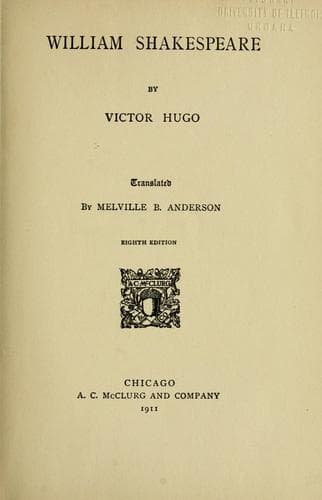
Dramatists, English -- Early modern, 1500-1700 -- Biography; Shakespeare, William, 1564-1616; Stratford-upon-Avon (England) -- Biography
These twin actions are, moreover, the sign of the sixteenth century.
Each epoch has its own mysterious stamp. The centuries have a seal that
they affix to _chefs-d'œuvre_, and which it is necessary to know how
to decipher and recognize. The seal of the sixteenth century is not
the seal of the eighteenth. The Renaissance was a subtle time,--a time
of reflection. The spirit of the sixteenth century was reflected in a
mirror. Every idea of the Renaissance has a double compartment. Look
at the jubes in the churches. The Renaissance, with an exquisite and
fantastical art, always makes the Old Testament repercussive on the
New. The twin action is there in everything. The symbol explains the
personage in repeating his gesture. If, in a basso-rilievo, Jehovah
sacrifices his son, he has close by, in the next low relief, Abraham
sacrificing his son. Jonas passes three days in the whale, and Jesus
passes three days in the sepulchre; and the jaws of the monster
swallowing Jonas answer to the mouth of hell engulfing Jesus.
The carver of the jube of Fécamp, so stupidly demolished, goes so far
as to give for counterpart to Saint Joseph--whom? Amphitryon.
These singular results constitute one of the habits of that profound
and searching high art of the sixteenth century. Nothing can be more
curious in that style than the part ascribed to Saint Christopher.
In the Middle Ages, and in the sixteenth century, in paintings and
sculptures, Saint Christopher, the good giant martyred by Decius in
250, recorded by the Bollandists and acknowledged without a question
by Baillet, is always triple,--an opportunity for the triptych. There
is foremost a first Christ-bearer, a first Christophorus; that is
Christopher, with the infant Jesus on his shoulders. Afterward the
Virgin enceinte is a Christopher, since she carries Christ Last,
the cross is a Christopher; it also carries Christ. This treble
illustration of the idea is immortalized by Rubens in the cathedral
of Antwerp. The twin idea, the triple idea,--such is the seal of the
sixteenth century.
Shakespeare, faithful to the spirit of his time, must needs add Laërtes
avenging his father to Hamlet avenging his father, and cause Hamlet
to be persecuted by Laërtes at the same time that Claudius is pursued
by Hamlet; he must needs make the filial piety of Edgar a comment on
the filial piety of Cordelia, and bring out in contrast, weighed down
by the ingratitude of unnatural children, two wretched fathers, each
bereaved of a kind light,--Lear mad, and Gloster blind.
[Footnote 1: Preface to "Cromwell."]
CHAPTER II.
Public-domain text, read in full here on John Shaqi.
Reviews
Reviews
No reviews yet
Be the first to share your thoughts on this work.
Elsewhere in the archive
Join the Discussion
Join the discussion
Sign in to leave a comment or review.
Sign InorCreate an account