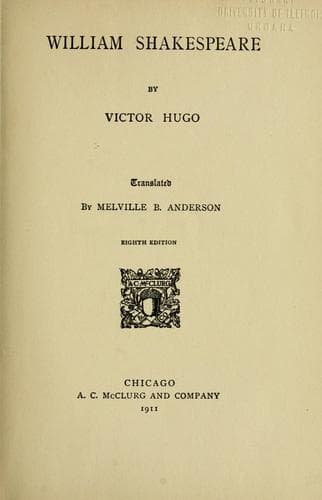
Dramatists, English -- Early modern, 1500-1700 -- Biography; Shakespeare, William, 1564-1616; Stratford-upon-Avon (England) -- Biography
And it is thus that the infusoria of Shakespeare is connected with the
giant of Æschylus.
The fairy, drawn over the nose of sleeping men in her carriage, covered
with the wing of a locust, by eight flies harnessed with the rays of
the moon, and whipped with a gossamer,--the fairy atom has for ancestor
the huge Titan, robber of stars, nailed on the Caucasus, one hand on
the Caspian gates, the other on the portals of Ararat, one heel on
the source of the Phasis, the other on the Validus-Murus, closing the
passage between the mountain and the sea,--a colossus, whose immense
shadow was, according as the rise or setting of light, projected by the
sun, now on Europe as far as Corinth, now on Asia as far as Bangalore.
Nevertheless, Mab, who is also called Tanaquil, has all the wavering
inconsistency of the dream. Under the name of Tanaquil she is the
wife of Tarquin the Ancient; and she spins for young Servius Tullius
the first tunic worn by a young Roman after leaving off the pretexta.
Oberon, who turns out to be Numa, is her uncle. In "Huon de Bordeaux"
she is called Gloriande, and has for lover Julius Cæsar, and Oberon is
her son; in Spenser, she is called Gloriana, and Oberon is her father;
in Shakespeare she is called Titania, and Oberon is her husband.
Titania: this name unites Mab to the Titan, and Shakespeare to Æschylus.
[Footnote 1: All the biography, sometimes rather puerile, even rather
silly, of Bishop Myriel.--Lamartine: _Cours de Littérature_ (Entretien
LXXXIV. p. 385).]
CHAPTER IV.
An eminent man of our day, a celebrated historian a powerful orator,
one of the former translators of Shakespeare, is mistaken, according to
our views, when he regrets, or appears to regret, the slight influence
of Shakespeare on the theatre of the nineteenth century. We cannot
share that regret An influence of any sort, even that of Shakespeare,
could but mar the originality of the literary movement of our epoch.
"The system of Shakespeare," says the honourable and grave writer,
with reference to that movement, "can furnish, it seems to me, the
plans after which genius must henceforth work." We have never been of
that opinion, and we have said so as far back as forty years ago.[1]
For us, Shakespeare is a genius, and not a system. On this point we
have already explained our views, and we mean soon to explain them at
greater length; but let us state now that what Shakespeare has done,
is done once for all,--it is impossible to do it over again. Admire or
criticise, but do not recast. It is finished.
Public-domain text, read in full here on John Shaqi.
Reviews
Reviews
No reviews yet
Be the first to share your thoughts on this work.
Elsewhere in the archive
Join the Discussion
Join the discussion
Sign in to leave a comment or review.
Sign InorCreate an account