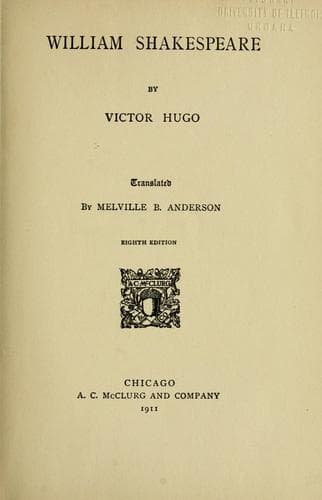
Dramatists, English -- Early modern, 1500-1700 -- Biography; Shakespeare, William, 1564-1616; Stratford-upon-Avon (England) -- Biography
To admire, to be an enthusiast,--it has struck me that it was right to
give in our century this example of folly.
CHAPTER III.
Do not look, then, for any criticism. I admire Æschylus, I admire
Juvenal, I admire Dante, in the mass, in a lump, all. I do not cavil
at those great benefactors. What you characterize as a fault, I call
accent. I accept and give thanks. I do not inherit the marvels of
human wit conditionally. Pegasus being given to me, I do not look
the gift-horse in the mouth. A masterpiece offers its hospitality:
I approach it with my hat off, and think the visage of mine host
handsome. Gilles Shakespeare, it may be: I admire Shakespeare and I
admire Gilles. Falstaff is proposed to me: I accept him, and I admire
the "Empty the jorden." I admire the senseless cry, "A rat!" I admire
the jests of Hamlet; I admire the wholesale murders of Macbeth; I
admire the witches, "that ridiculous spectacle;" I admire "the buttock
of the night;" I admire the eye plucked from Gloster. I am simple
enough to admire all.
Having recently had the honour to be called "silly" by several
distinguished writers and critics, and even by my illustrious friend M.
de Lamartine,[1] I am determined to justify the epithet.
We close with one last observation which we have specially to make
regarding Shakespeare.
Orestes, that fatal senior of Hamlet, is not, as we have said, the
sole link between Æschylus and Shakespeare; we have noted a relation,
less easily perceptible, between Prometheus and Hamlet. The mysterious
close connection between the two poets is, in reference to this same
Prometheus, more strangely striking yet, and in a particular which, up
to this time, has escaped the observers and critics. Prometheus is the
grandsire of Mab.
Let us prove it.
Prometheus, like all personages become legendary,--like Solomon, like
Cæsar, like Mahomet, like Charlemagne, like the Cid, like Joan of Arc,
like Napoleon,--has a double prolongation, the one in history, the
other in fable. Now, the prolongation of Prometheus is this:
Prometheus, creator of men, is also creator of spirits. He is father
of a dynasty of Divs, whose filiation the old metrical tales have
preserved: Elf, that is to say, the Rapid, son of Prometheus; then
Elfin, King of India; then Elfinan, founder of Cleopolis, town of the
fairies; then Elfilin, builder of the golden wall; then Elfinell,
winner of the battle of the demons; then Elfant, who made Panthea
entirely in crystal; then Elfar, who killed Bicephalus and Tricephalus;
then Elfinor, the magian, a kind of Salmoneus, who built over the sea
a bridge of copper, sounding like thunder, "non imitabile fulmen aere
et cornipedum pulsu simularat equorum;" then seven hundred princes;
then Elficleos the Sage; then Elferon the Beautiful; then Oberon; then
Mab,--wonderful fable, which, with a profound meaning, unites the
sidereal and the microscopic, the infinitely great and the infinitely
small.
Public-domain text, read in full here on John Shaqi.
Reviews
Reviews
No reviews yet
Be the first to share your thoughts on this work.
Elsewhere in the archive
Join the Discussion
Join the discussion
Sign in to leave a comment or review.
Sign InorCreate an account