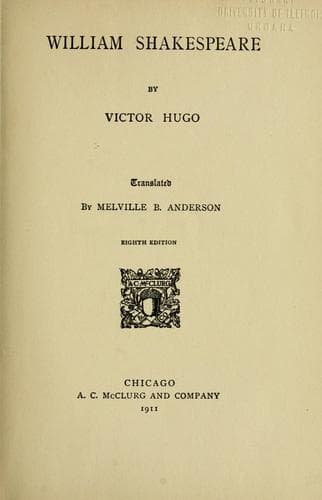
Dramatists, English -- Early modern, 1500-1700 -- Biography; Shakespeare, William, 1564-1616; Stratford-upon-Avon (England) -- Biography
10. Shakespeare went from time to time to pass some days at New Place.
In these short journeys he met half-way Oxford, and at Oxford the
Crown Hotel, and in the hotel the hostess, a beautiful, intelligent
creature, wife of the worthy innkeeper, Davenant. In 1606 Mrs. Davenant
was brought to bed of a son whom they named William, and in 1644
Sir William Davenant, created knight by Charles I., wrote to Lord
Rochester: "Know this, which does honour to my mother, I am the son
of Shakespeare," thus allying himself to Shakespeare in the same way
that in our days M. Lucas Montigny claimed relationship with Mirabeau.
Shakespeare had married off his two daughters,--Susan to a doctor,
Judith to a merchant; Susan had wit, Judith knew not how to read or
write, and signed her name with a cross. In 1613 it happened that
Shakespeare, having come to Stratford-on-Avon, had no further desire
to return to London. Perhaps he was in difficulties. He had just been
compelled to mortgage his house. The contract deed of this mortgage,
dated 11th March, 1613, and indorsed with Shakespeare's signature,
was up to the last century in the hands of an attorney, who gave it
to Garrick, who lost it. Garrick lost likewise (it is Miss Violetti,
his wife, who tells the story), Forbes's manuscript, with his letters
in Latin. From 1613 Shakespeare remained at his house at New Place,
occupied with his garden, forgetting his plays, wrapped up in his
flowers. He planted in this garden of New Place the first mulberry-tree
that was grown at Stratford, just as Queen Elizabeth wore, in 1561, the
first silk stockings seen in England. On the 25th March, 1616, feeling
ill, he made his will. His will, dictated by him, is written on three
pages; he signed each of them; his hand trembled. On the first page
he signed only his Christian name, "William;" on the second, "Willm.
Shaspr.;" on the third, "William Shasp." On the 23d April, he died.
He had reached that day exactly fifty-two years, being born on the
23d April, 1564. On that same day, 23d April, 1616, died Cervantes, a
genius of like growth. When Shakespeare died, Milton was eight years,
Corneille ten years of age; Charles I. and Cromwell were two youths,
the one sixteen, the other seventeen years old.
[Footnote 1: See L'Inferno, Chant xx.]
CHAPTER IV.
Shakespeare's life was greatly imbittered. He lived perpetually
slighted; he states it himself. Posterity may read this to-day in his
own verses:--
"Thence comes it that my name receives a brand,
And almost thence my nature is subdu'd.
Pity me, then,
Whilst, like a willing patient, I will drink
Potions of eysel."[1]
"Your love and pity doth th' impression fill
Which vulgar scandal stamp'd upon my brow."[2]
"Nor thou with public kindness honour me,
Unless thou take that honour from thy name."[3]
"Or on my frailty why are frailer spies."[4]
Public-domain text, read in full here on John Shaqi.
Reviews
Reviews
No reviews yet
Be the first to share your thoughts on this work.
Join the Discussion
Join the discussion
Sign in to leave a comment or review.
Sign InorCreate an account