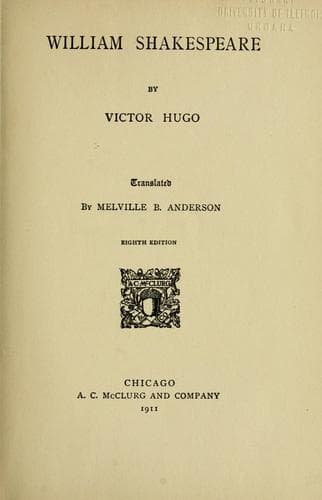
Dramatists, English -- Early modern, 1500-1700 -- Biography; Shakespeare, William, 1564-1616; Stratford-upon-Avon (England) -- Biography
Examine Shakespeare, dive into him, and see how determined he is to
be himself. Do not expect any concession from him. It is not egotism,
but it is stubbornness. He wills it. He gives to art his orders,--of
course in the limits of his work; for neither the art of Æschylus,
nor the art of Aristophanes, nor the art of Plautus, nor the art of
Macchiavelli, nor the art of Calderon, nor the art of Molière, nor the
art of Beaumarchais, nor any of the forms of art, deriving life each
of them from the special life of a genius, would obey the orders given
by Shakespeare. Art, thus understood, is vast equality and profound
liberty; the region of the equals is also the region of the free.
One of the grandeurs of Shakespeare consists in his impossibility
to be a model. In order to realize his idiosyncrasy, open one of
his plays,--no matter which; it is always foremost and above all
Shakespeare.
What more personal than "Troilus and Cressida"? A comic Troy! Here
is "Much Ado about Nothing,"--a tragedy which ends with a burst of
laughter. Here is the "Winter's Tale,"--a pastoral drama. Shakespeare
is at home in his work. Do you wish to see true despotism: look at his
fancy. What arbitrary determination to dream! What despotic resolution
in his vertiginous flight! What absoluteness in his indecision and
wavering! The dream fills some of his plays to that degree that man
changes his nature, and is the cloud more than the man. Angelo in
"Measure for Measure" is a misty tyrant. He becomes disintegrated,
and wears away. Leontes in the "Winter's Tale" is an Othello who
is blown away. In "Cymbeline" one thinks that Iachimo will become
an Iago, but he melts down. The dream is there,--everywhere. Watch
Manilius, Posthumus, Hermione, Perdita, passing by. In the "Tempest,"
the Duke of Milan has "a brave son," who is like a dream in a dream.
Ferdinand alone speaks of him, and no one but Ferdinand seems to have
seen him. A brute becomes reasonable: witness the constable Elbow in
"Measure for Measure." An idiot is all at once witty: witness Cloten in
"Cymbeline." A King of Sicily is jealous of a King of Bohemia. Bohemia
has a seashore. The shepherds pick up children there. Theseus, a duke,
espouses Hippolyta, the Amazon. Oberon comes in also. For here it is
Shakespeare's will to dream; elsewhere he thinks.
We say more: where he dreams he still thinks,--with a different but
equal depth.
Let men of genius remain in peace in their originality. There is
something wild in these mysterious civilizers. Even in their comedy,
even in their buffoonery, even in their laughter, even in their smile,
there is the unknown. In them is felt the sacred dread that belongs to
art, and the all-powerful terror of the imaginary mixed with the real.
Each of them is in his cavern, alone. They hear one another from afar,
but never copy one another. We are not aware that the hippopotamus
imitates the roar of the elephant, neither do lions imitate one another.
Public-domain text, read in full here on John Shaqi.
Reviews
Reviews
No reviews yet
Be the first to share your thoughts on this work.
Elsewhere in the archive
Join the Discussion
Join the discussion
Sign in to leave a comment or review.
Sign InorCreate an account