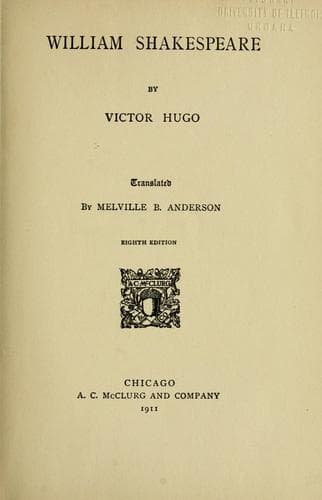
Dramatists, English -- Early modern, 1500-1700 -- Biography; Shakespeare, William, 1564-1616; Stratford-upon-Avon (England) -- Biography
Diderot does not recast Bayle; Beaumarchais does not copy Plautus, and
has no need of Davus to create Figaro. Piranesi is not inspired by
Dædalus. Isaiah does not begin Moses over again.
One day, at St. Helena, M. De Las Cases said, "Sire, when you were
master of Prussia, I would in your place have taken the sword of
Frederick the Great, which is deposited in the tomb at Potsdam; and I
would have worn it." "Fool!" replied Napoleon, "I had my own."
Shakespeare's work is absolute, sovereign, imperious, eminently
solitary, unneighbourly, sublime in radiance, absurd in reflection, and
must remain without a copy.
To imitate Shakespeare would be as insane as to imitate Racine would be
stupid.
CHAPTER VI.
Let us agree, by the way, respecting a qualificative much used
everywhere: _Profanum vulgus_,--the saying of a poet on which pedants
lay great stress. This _profanum vulgus_ is rather the weapon of
everybody. Let us fix the meaning of this word. What is the _profanum
vulgus?_ The school says, "It is the people." And we, we say, "It is
the school."
But let us first define this expression, "the school." When we say,
"the school," what must be understood? Let us explain it. The school
is the resultant of pedantry; the school is the literary excrescence
of the budget; the school is intellectual mandarinship governing in
the various authorized and official teachings, either of the press
or of the State, from the theatrical _feuilleton_ of the prefecture
to the biographies and encyclopædias duly examined, stamped, and
hawked about, and sometimes, as a refinement, made by republicans
agreeable to the police; the school is the circumvallating classic and
scholastic orthodoxy, the Homeric and Virgilian antiquity made use of
by _literati_ licensed by government,--a kind of China self-called
Greece; the school is--summed up in one concretion which forms part
of public order--all the knowledge of pedagogues, all the history of
historiographers, all the poetry of laureates, all the philosophy
of sophists, all the criticism of pedants, all the ferule of the
"ignorantins," all the religion of bigots, all the modesty of prudes,
all the metaphysics of those who change sides, all the justice of
placemen, all the old age of the small young men who have undergone
the operation, all the flattery of courtiers, all the diatribes of
censer-bearers, all the independence of valets, all the certainty
of short sights and of base souls. The school hates Shakespeare. It
detects him in the very act of mingling with the people, going to and
fro in public thoroughfares, "trivial," speaking the language of the
people, uttering the human cry like any other man, welcome to those
that he welcomes, applauded by hands black with tar, cheered by all
the hoarse throats that proceed from labour and weariness. The drama
of Shakespeare is the people; the school is indignant and says, "Odi
profanum vulgus." There is demagogy in this poetry roaming at large;
Public-domain text, read in full here on John Shaqi.
Reviews
Reviews
No reviews yet
Be the first to share your thoughts on this work.
Elsewhere in the archive
Join the Discussion
Join the discussion
Sign in to leave a comment or review.
Sign InorCreate an account