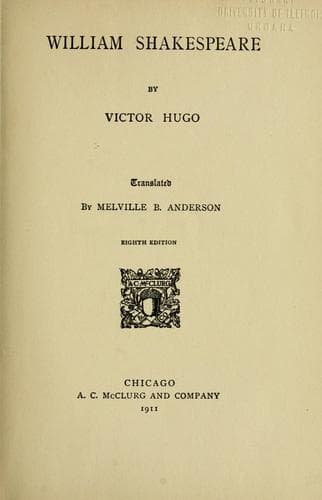
Dramatists, English -- Early modern, 1500-1700 -- Biography; Shakespeare, William, 1564-1616; Stratford-upon-Avon (England) -- Biography
the author of "Hamlet" "panders to the mob."
Let it be so. The poet "panders to the mob."
If anything is great, it is that.
There in the foreground, everywhere, in full light, amidst the flourish
of trumpets, are the powerful men followed by the gilded men. The poet
does not see them, or, if he does, he disdains them. He lifts his eyes
and looks at God; then he lowers his eyes and looks at the people.
There in the depth of the shadow, nearly invisible, so much submerged
that it is the night, is that fatal crowd, that vast and mournful
heap of suffering, that venerable populace of the tattered and of the
ignorant,--chaos of souls. That crowd of heads undulates obscurely
like the waves of a nocturnal sea. From time to time there pass on
that surface, like squalls over the water, catastrophes,--a war, a
pestilence, a royal favourite, a famine. That causes a disturbance
which lasts a short time, the depth of sorrow being immovable as the
depth of the ocean. Despair deposits in us some weight as of lead.
The last word of the abyss is stupor; therefore it is the night. It
is, under the thick blackness, behind which all is indistinct, the
mournful sea of the needy.
These overloaded beings are silent; they know nothing; they submit
_Plectuntur Achivi._ They are hungry and cold. Their indecent flesh is
seen through the holes in their tatters. Who makes those tatters? The
purple. The nakedness of virgins comes from the nudity of odalisques.
From the twisted rags of the daughters of the people fall pearls for
the Fontanges and the Châteauroux. It is famine which gilds Versailles.
The whole of that living and dying shadow moves; these larvæ are in the
pangs of death; the mother's breast is dry; the father has no work;
the brains have no light. If there is a book in that destitution, it
resembles the pitcher, so insipid or corrupt is what it offers to the
thirst of intellects. Mournful families!
The group of the little ones is wan. All die away and creep along, not
having even the power to love; and unknown to them perhaps, while they
crouch down and resign themselves, from all that vast unconsciousness
in which Right dwells, from the rumbling murmur of those wretched
breaths mingled together, proceeds an indescribable confused voice,
mysterious mist of language, succeeding, syllable by syllable in the
darkness, in uttering extraordinary words,--Future, Humanity, Liberty,
Equality, Progress. And the poet listens, and he hears; and he looks,
and he sees; and he bends lower and lower, and he weeps; and all at
once, growing with a strange growth, drawing from all that darkness his
own transfiguration, he stands erect, terrible and tender, above all
those wretched ones,--those above as well as those below,--with flaming
eyes.
Public-domain text, read in full here on John Shaqi.
Reviews
Reviews
No reviews yet
Be the first to share your thoughts on this work.
Elsewhere in the archive
Join the Discussion
Join the discussion
Sign in to leave a comment or review.
Sign InorCreate an account