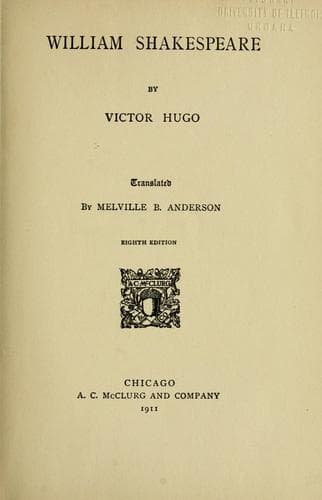
Dramatists, English -- Early modern, 1500-1700 -- Biography; Shakespeare, William, 1564-1616; Stratford-upon-Avon (England) -- Biography
Macchiavelli had a strange idea of the people. To heap the measure,
to overflow the cup, to exaggerate horror in the case of the prince,
to increase the crushing in order to stir up the oppressed to revolt,
to cause idolatry to change into a curse, to push the masses to
extremities,--such seems to be his policy. His "yes" signifies "no." He
loads the despot with despotism in order to make him burst. The tyrant
becomes in his hands a hideous projectile, which will break to pieces.
Macchiavelli conspires. For whom? Against whom? Guess. His apotheosis
of kings is just the thing to make regicides. On the head of his prince
he places a diadem of crimes, a tiara of vices, a halo of baseness; and
he invites you to adore his monster, with the air of a man expecting
an avenger. He glorifies evil with a squint toward the darkness,--the
darkness wherein is Harmodius. Macchiavelli, the getter-up of princely
outrages, the valet of the Medici and of the Borgias, had in his youth
been put to the rack for having admired Brutus and Cassius. He had
perhaps plotted with the Soderini the deliverance of Florence. Does
he recollect it? Does he continue? His advice is followed, like the
lightning, by a low rumbling in the cloud,--alarming reverberation.
What did he mean to say? On whom has he a design? Is the advice for or
against him to whom he gives it? One day, at Florence, in the garden
of Cosmo Ruccelaï, there being present the Duke of Mantua and John de
Medici, who afterward commanded the Black Bands of Tuscany, Varchi,
the enemy of Macchiavelli, heard him say to the two princes: "Let the
people read no book,--not even mine." It is curious to compare with
this remark the advice given by Voltaire to the Duke de Choiseul,--at
the same time advice to the minister, and insinuation for the king:
"Let the boobies read our nonsense. There is no danger in reading, my
lord. What can a great king like the King of France fear? The people
are but rabble, and the books are but trash." Let them read nothing,
let them read everything: these two pieces of contrary advice coincide
more than one would think. Voltaire, with hidden claws, is purring at
the feet of the king, Voltaire and Macchiavelli are two formidable
indirect revolutionists, dissimilar in everything, and yet identical
in reality by their profound hatred, disguised in flattery, of the
master. The one is malignant, the other is sinister. The princes of the
sixteenth century had as theorist on their infamies, and as enigmatical
courtier, Macchiavelli, an enthusiast dark at heart. The flattery of a
sphinx,--terrible thing! Better yet be flattered, like Louis XV., by a
cat.
Conclusion: Make the people read Macchiavelli, and make them read
Voltaire.
Macchiavelli will inspire them with horror of, and Voltaire with
contempt for, crowned guilt.
But the hearts should turn, above all, toward the grand pure poets,
whether they be sweet like Virgil or bitter like Juvenal.
CHAPTER VII.
Public-domain text, read in full here on John Shaqi.
Reviews
Reviews
No reviews yet
Be the first to share your thoughts on this work.
Elsewhere in the archive
Join the Discussion
Join the discussion
Sign in to leave a comment or review.
Sign InorCreate an account