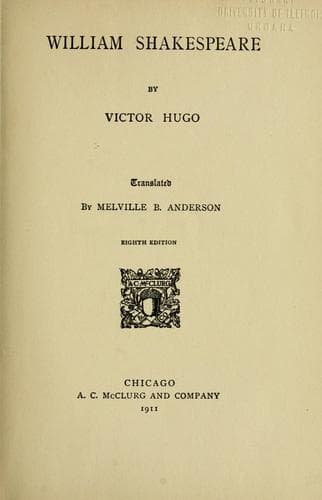
Dramatists, English -- Early modern, 1500-1700 -- Biography; Shakespeare, William, 1564-1616; Stratford-upon-Avon (England) -- Biography
The progress of man by the education of minds,--there is no safety but
in that. Teach! learn! All the revolutions of the future are enclosed
and imbedded in this phrase: Gratuitous and obligatory instruction.
It is by the unfolding of works of the highest order that this vast
intellectual teaching should be crowned. At the top the men of genius.
Wherever there is a gathering of men, there ought to be in a special
place, a public expositor of the great thinkers.
By a great thinker we mean a beneficent thinker.
The perpetual presence of the beautiful in their works maintains poets
at the summit of teaching.
No one can foresee the quantity of light which will be brought forth
by letting the people be in communication with men of genius. This
combination of the hearts of the people with the heart of the poet will
be the Voltaic pile of civilization.
Will the people understand this magnificent teaching? Certainly. We
know of nothing too lofty for the people. The people are a great soul.
Have you ever gone on a fête-day to a theatre open gratuitously to
all? What do you think of that auditory? Do you know of any other
more spontaneous and intelligent? Do you know, even in the forest,
of a vibration more profound? The court of Versailles admires like a
well-drilled regiment; the people throw themselves passionately into
the beautiful. They pack together, crowd, amalgamate, combine, and
knead themselves in the theatre,--a living paste that the poet is about
to mould. The powerful thumb of Molière will presently make its mark
on it; the nail of Corneille will scratch this ill-shaped heap. Whence
does that heap come? Whence does it proceed? From the Courtille, from
the Porcherons, from the Cunette; it is shoeless, it is bare-armed, it
is ragged. Silence! This is the human block.
The house is crowded, the vast multitude looks, listens, loves; all
consciences, deeply moved, throw off their inner fire; all eyes
glisten; the huge beast with a thousand heads is there,--the Mob of
Burke, the _Plebs_ of Titus Livius, the _Fex urbis_ of Cicero. It
caresses the beautiful; smiling at it with the grace of a woman. It
is literary in the most refined sense of the word; nothing equals the
delicacy of this monster. The tumultuous crowd trembles, blushes,
palpitates. Its modesty is surprising; the crowd is a virgin. No
prudery however; this brute is not brutal. Not a sympathy escapes
it; it has in itself the whole keyboard, from passion to irony, from
sarcasm to sobbing. Its compassion is more than compassion; it is real
mercy. God is felt in it. All at once the sublime passes, and the
sombre electricity of the abyss heaves up suddenly all this pile of
hearts and entrails; enthusiasm effects a transfiguration. And now,
is the enemy at the gates, is the country in danger? Appeal to that
populace, and it would enact the sublime drama of Thermopylæ. Who has
called forth such a metamorphosis? Poetry.
Public-domain text, read in full here on John Shaqi.
Reviews
Reviews
No reviews yet
Be the first to share your thoughts on this work.
Elsewhere in the archive
Join the Discussion
Join the discussion
Sign in to leave a comment or review.
Sign InorCreate an account