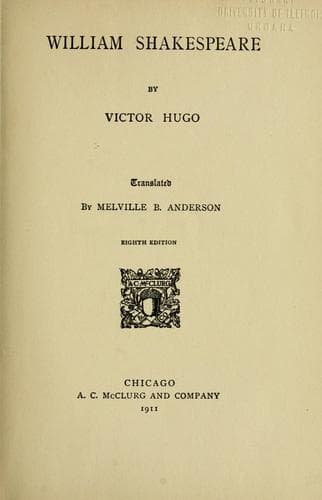
Dramatists, English -- Early modern, 1500-1700 -- Biography; Shakespeare, William, 1564-1616; Stratford-upon-Avon (England) -- Biography
What an aim,--to make the people! Principles combined with science;
every possible quantity of the absolute introduced by degrees into the
fact; Utopia treated successively by every mode of realization,--by
political economy, by philosophy, by physics, by chemistry, by
dynamics, by logic, by art; union replacing little by little
antagonism, and unity replacing union; for religion God, for priest the
father, for prayer virtue, for field the whole earth, for language the
verb, for law the right, for motive-power duty, for hygiene labour,
for economy universal peace, for canvas the very life, for the goal
progress, for authority liberty, for people the man,--such is the
simplification.
And at the summit the ideal.
The ideal!--inflexible type of perpetual progress.
To whom belong men of genius, if not to thee, people? They do belong to
thee; they are thy sons and thy fathers. Thou givest birth to them, and
they teach thee. They open in thy chaos vistas of light. Children, they
have drunk thy sap. They have leaped in the universal matrix, humanity.
Each of thy phases, people, is an avatar. The deep essence of life,
it is in thee that it must be looked for. Thou art the great bosom.
Geniuses are begotten from thee, mysterious crowd.
Let them therefore return to thee.
People, the author, God, dedicates them to thee.
BOOK VI.
THE BEAUTIFUL THE SERVANT OF THE TRUE.
CHAPTER I.
Ah, minds, be useful! Be of some service. Do not be fastidious when it
is necessary to be efficient and good. Art for art may be beautiful,
but art for progress is more beautiful yet. To dream revery is well,
to dream Utopia is better. Ah, you must think? Then think of making
man better. You must dream? Here is the dream for you,--the ideal. The
prophet seeks solitude, but not isolation. He unravels and untwists
the threads of humanity, tied and rolled in a skein in his soul; he
does not break them. He goes into the desert to think--of whom? Of
the multitude. It is not to the forests that he speaks; it is to the
cities, It is not at the grass bending to the wind that he looks; it is
at man. It is not against lions that he wars; it is against tyrants.
Woe to thee, Ahab! woe to thee, Hosea! woe to you, kings! woe to you,
Pharaohs! is the cry of the great solitary one. Then he weeps.
For what? For that eternal captivity of Babylon, undergone by Israel
formerly, undergone by Poland, by Roumania, by Hungary, by Venice
to-day. He grows old, the good and dark thinker; he watches, he lies
in wait, he listens, he looks,--ear in the silence, eye in the night,
claw half stretched toward the wicked. Go and speak to him, then, of
art for art, to that cenobite of the ideal. He has his aim, and he
walks straight toward it; and his aim is this: improvement. He devotes
himself to it.
Public-domain text, read in full here on John Shaqi.
Reviews
Reviews
No reviews yet
Be the first to share your thoughts on this work.
Elsewhere in the archive
Join the Discussion
Join the discussion
Sign in to leave a comment or review.
Sign InorCreate an account