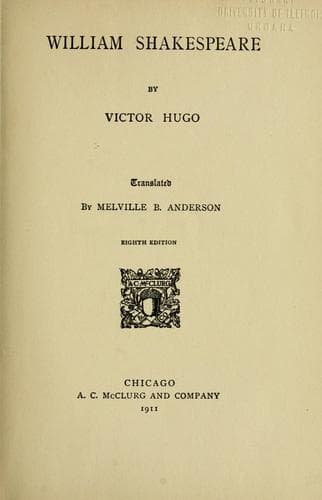
Dramatists, English -- Early modern, 1500-1700 -- Biography; Shakespeare, William, 1564-1616; Stratford-upon-Avon (England) -- Biography
He does not belong to himself; he belongs to his apostleship. He is
intrusted with that immense care,--the progress of the human race.
Genius is not made for genius, it is made for man. Genius on earth
is God giving himself. Each time that a masterpiece appears, it is a
distribution of God that takes place. The masterpiece is a variety of
the miracle. Thence, in all religions, and among all peoples, comes
faith in divine men. They deceive themselves, those who think that we
deny the divinity of Christs.
At the point now reached by the social question, everything should be
action in common. Forces isolated frustrate one another; the ideal and
the real strengthen each other. Art necessarily aids science. These two
wheels of progress should turn together.
Generation of new talents, noble group of writers and poets, legion
of young men, O living posterity of my country, your elders love
and salute you! Courage! let us consecrate ourselves. Let us devote
ourselves to the good, to the true, to the just. In that there is
goodness.
Some pure lovers of art, affected by a preoccupation which in its
way has its dignity and nobleness, discard this formula, "Art for
progress," the Beautiful Useful, fearing lest the useful should deform
the beautiful. They tremble lest they should see attached to the fine
arms of the Muse the coarse hands of the drudge. According to them, the
ideal may become perverted by too much contact with reality. They are
solicitous for the sublime if it is lowered as far as humanity. Ah,
they are mistaken.
The useful, far from circumscribing the sublime, increases it. The
application of the sublime to human things produces unexpected
_chefs-d'œuvre._ The useful, considered in itself and as an element
combining with the sublime, is of several kinds; there is the useful
which is tender, and there is the useful which is indignant. Tender, it
refreshes the unfortunate and creates the social epopee; indignant, it
flagellates the wicked, and creates the divine satire. Moses hands the
rod to Jesus; and after having caused the water to gush from the rock,
that august rod, the very same, drives the vendors from the sanctuary.
What! art should grow less because it has expanded? No. One service
more is one more beauty.
Public-domain text, read in full here on John Shaqi.
Reviews
Reviews
No reviews yet
Be the first to share your thoughts on this work.
Elsewhere in the archive
Join the Discussion
Join the discussion
Sign in to leave a comment or review.
Sign InorCreate an account