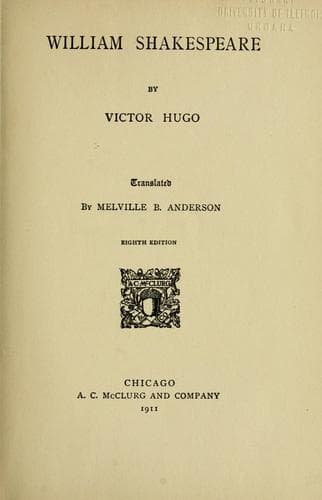
Dramatists, English -- Early modern, 1500-1700 -- Biography; Shakespeare, William, 1564-1616; Stratford-upon-Avon (England) -- Biography
For certain sublime beings, to soar is to serve. In the desert not a
drop of water,--a horrible thirst; the wretched file of pilgrims drag
along overcome. All at once, in the horizon, above a wrinkle in the
sands, a griffin is seen soaring, and all the caravan cry out, "There
is water there!"
What thinks Æschylus of art as art? Certainly, if ever a poet was a
poet, it is Æschylus. Listen to his reply. It is in the "Frogs" of
Aristophanes, line 1039. Æschylus speaks:--
"Since the beginning of time, the illustrious poet has
served men. Orpheus has taught the horror of murder, Musæus
oracles and medicine, Hesiod agriculture, and that divine
Homer, heroism. And I, after Homer, I have sung Patroclus,
and Teucer the lion-hearted; so that every citizen should
try to resemble the great men."
As all the sea is salt, so all the Bible is poetry. This poetry talks
politics at its own hours. Open 1 Samuel, chapter VIII. The Jewish
people demand a king:
"...And the Lord said unto Samuel, Hearken unto the voice
of the people in all that they say unto thee; for they have
not rejected thee, but they have rejected me, that I should
not reign over them.... And Samuel told all the words of the
Lord unto the people that asked of him a king. And he said,
This will be the manner of the king that shall reign over
you: He will take your sons and appoint them for himself,
for his chariots, and to be his horsemen; and some shall
run before his chariots.... And he will take your daughters
to be confectionaries, and to be cooks, and to be bakers.
And he will take your fields, and your vineyards, and your
oliveyards, even the best of them, and give them to his
servants. And he will take your men-servants, and your
maid-servants, and your goodliest young men, and your asses,
and put them to his work. He will take the tenth of your
sheep: and ye shall be his servants. And ye shall cry out
in that day because of your king which ye shall have chosen
you; and the Lord will not hear you in that day."
Samuel, we see, denies the right divine; Deuteronomy shakes the
altar,--the false altar, let us observe; but is not the next altar
always the false altar? "You shall demolish the altars of the false
gods. You shall seek God where he dwells." It is almost Pantheism.
Because it takes part in human things, is democratic here, iconoclast
there, is that book less magnificent and less supreme? If poetry is not
in the Bible, where is it?
You say: The muse is made to sing, to love, to believe, to pray. Yes
and no. Let us understand each other. To sing whom? The void. To love
what? One's self. To believe in what? The dogma. To pray to what? The
idol. No, here is the truth: To sing the ideal, to love humanity, to
believe in progress, to pray to the infinite.
Public-domain text, read in full here on John Shaqi.
Reviews
Reviews
No reviews yet
Be the first to share your thoughts on this work.
Elsewhere in the archive
Join the Discussion
Join the discussion
Sign in to leave a comment or review.
Sign InorCreate an account