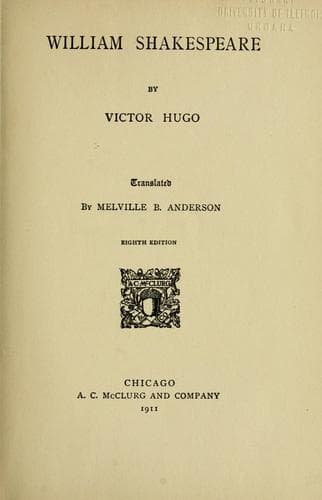
Dramatists, English -- Early modern, 1500-1700 -- Biography; Shakespeare, William, 1564-1616; Stratford-upon-Avon (England) -- Biography
Take care, you who are tracing those circles round the poet, you put
him beyond man. That the poet should be beyond humanity in one way,--by
the wings, by the immense flight, by the sudden possible disappearance
in the fathomless,--is well; it must be so, but on condition of
reappearance. He may depart, but he must return. Let him have wings
for the infinite, provided he has feet for the earth, and that, after
having been seen flying, he is seen walking. Let him become man again,
after he has gone out of humanity. After he has been seen an archangel,
let him be once more a brother. Let the star which is in that eye weep
a tear, and that tear be the human tear. Thus, human and superhuman, he
shall be the poet. But to be altogether beyond man, is not to be. Show
me thy foot, genius, and let us see if, like myself, thou hast earthly
dust on thy heel.
If thou hast not some of that dust, if thou hast never walked in my
pathway, thou dost not know me and I do not know thee. Go away. Thou
believest thyself an angel, thou art but a bird.
Help from the strong for the weak, help from the great for the small,
help from the free for the slaves, help from the thinkers for the
ignorant, help from the solitary for the multitudes,--such is the law,
from Isaiah to Voltaire. He who does not follow that law may be a
genius, but he is only a useless genius. By not handling the things of
the earth, he thinks to purify himself; he annuls himself. He is the
refined, the delicate, he may be the exquisite genius; he is not the
great genius. Any one, roughly useful, but useful, has the right to
ask on seeing that good-for-nothing genius: "Who is this idler?" The
amphora which refuses to go to the fountain deserves the hooting of the
pitchers.
Great is he who consecrates himself! Even when overcome, he remains
serene, and his misery is happiness. No, it is not a bad thing for the
poet to meet face to face with duty. Duty has a stern resemblance to
the ideal. The act of doing one's duty is worth all the trial it costs.
No, the jostling with Cato is not to be avoided. No, no, no; truth,
honesty, teaching the crowds, human liberty, manly virtue, conscience,
are not things to disdain. Indignation and emotion are but one faculty
turned toward the two sides of mournful human slavery; and those who
are capable of anger are capable of love. To level the tyrant and the
slave, what a magnificent effort! Now, the whole of one side of actual
society is tyrant, and all the other side is slave. To straighten this
out will be a wonderful thing to accomplish; yet it will be done. All
thinkers must work with that end in view. They will gain greatness in
that work. To be the servant of God in the march of progress and the
apostle of God with the people,--such is the law which regulates the
growth of genius.
[Illustration: _Portrait of Shakespeare._
Photogravure. From Mr. Ozias Humphry's Drawing of the Chandos. Picture
made for the late Mr. Malene in 1783.
Drawing of Mr. Malene]
Public-domain text, read in full here on John Shaqi.
Reviews
Reviews
No reviews yet
Be the first to share your thoughts on this work.
Elsewhere in the archive
Join the Discussion
Join the discussion
Sign in to leave a comment or review.
Sign InorCreate an account