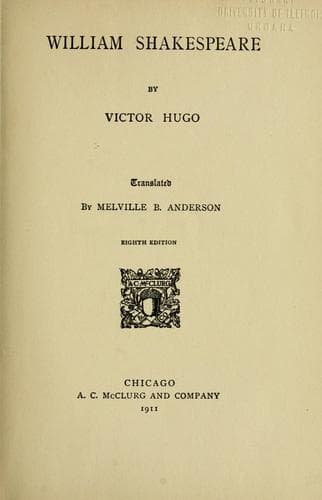
Dramatists, English -- Early modern, 1500-1700 -- Biography; Shakespeare, William, 1564-1616; Stratford-upon-Avon (England) -- Biography
Under this restoration of the Stuarts, Shakespeare completed his
eclipse. He was so thoroughly dead that Davenant, possibly his son,
re-composed his pieces. There was no longer any "Macbeth" but the
"Macbeth" of Davenant. Dryden speaks of Shakespeare on one occasion in
order to say that he is "out of date." Lord Shaftesbury calls him "a
wit out of fashion." Dryden and Shaftesbury were two oracles. Dryden,
a converted Catholic, had two sons, ushers in the Chamber of Clément
XI., made tragedies worth putting into Latin verse, as Atterbury's
hexameters prove; and he was the servant of that James II. who, before
being king on his own account, had asked of his brother, Charles II.,
"Why don't you hang Milton?" The Earl of Shaftesbury, a friend of
Locke, was the man who wrote an "Essay on Sprightliness in Important
Conversations," and who, by the manner in which Chancellor Hyde helped
his daughter to the wing of a chicken, divined that she was secretly
married to the Duke of York.
These two men having condemned Shakespeare, the oracle had spoken.
England, a country more obedient to conventional opinion than is
generally believed, forgot Shakespeare. Some purchaser pulled down
his house, New Place. A Rev. Dr. Cartrell cut down and burned his
mulberry-tree. At the commencement of the eighteenth century the
eclipse was total. In 1707, one called Nahum Tate published a "King
Lear," warning his readers "that he had borrowed the idea of it from a
play which he had read by chance,--the work of some nameless author."
This "nameless author" was Shakespeare.
[Footnote 1: Sonnet 111.]
[Footnote 2: Sonnet 112.]
[Footnote 3: Sonnet 36.]
[Footnote 4: Sonnet 121.]
CHAPTER V.
In 1728 Voltaire imported from England to France the name of Will
Shakespeare. Only in place of Will, he pronounced it _Gilles._
Jeering began in France, and oblivion continued in England. What
the Irishman Nahum Tate had done for "King Lear," others did for
other pieces. "All's Well that Ends Well" had successively two
arrangers,--Pilon for the Haymarket, and Kemble for Drury Lane.
Shakespeare existed no more, and counted no more. "Much Ado about
Nothing" served likewise as a rough draft twice,--for Davenant in
1673, for James Miller in 1737. "Cymbeline" was recast four times:
under James II., at the Theatre Royal, by Thomas Dursey; in 1695 by
Charles Marsh; in 1759 by W. Hawkins; in 1761 by Garrick. "Coriolanus"
was recast four times: in 1682, for the Theatre Royal, by Tates; in
1720, for Drury Lane, by John Dennis; in 1755, for Covent Garden, by
Thomas Sheridan; in 1801, for Drury Lane, by Kemble. "Timon of Athens"
was recast four times: at the Duke's Theatre, in 1678, by Shadwell;
in 1768, at the Theatre of Richmond Green, by James Love; in 1771, at
Drury Lane, by Cumberland; in 1786, at Covent Garden, by Hull.
Public-domain text, read in full here on John Shaqi.
Reviews
Reviews
No reviews yet
Be the first to share your thoughts on this work.
Join the Discussion
Join the discussion
Sign in to leave a comment or review.
Sign InorCreate an account